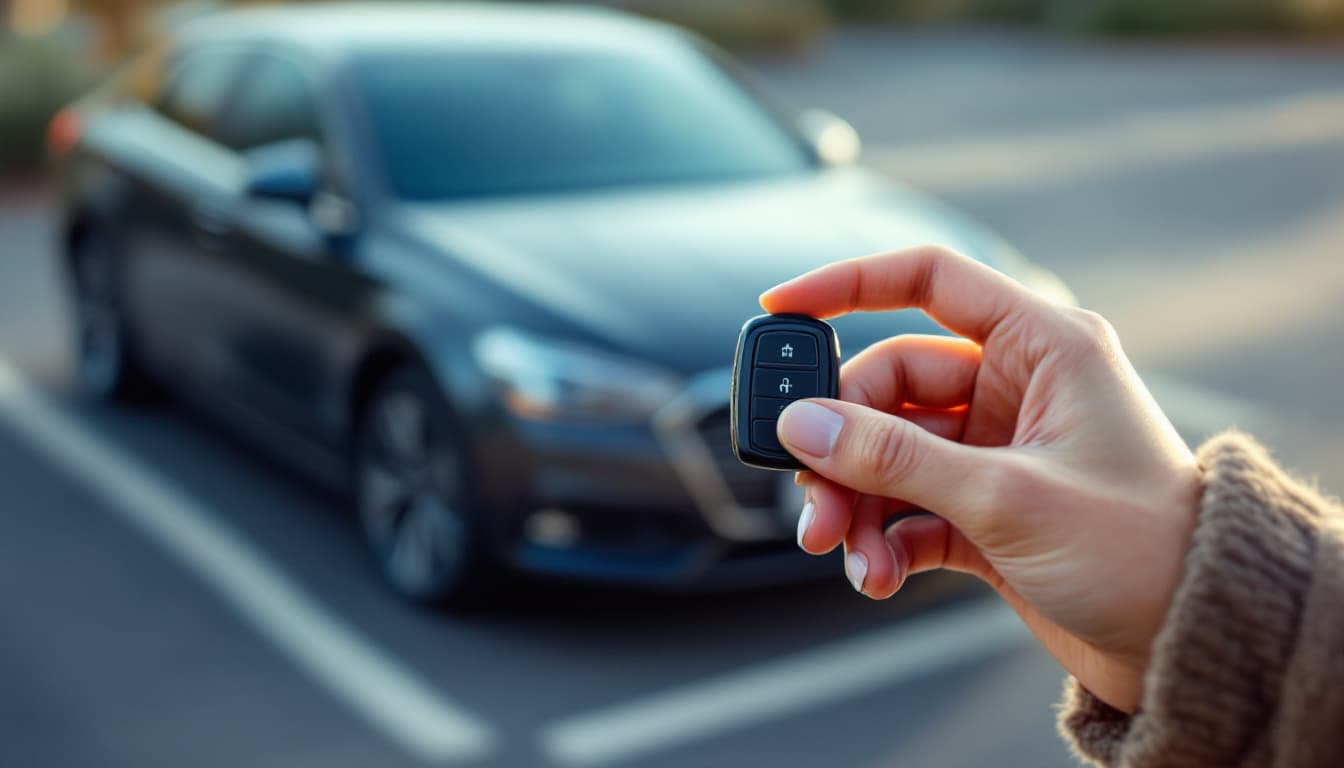
A fob that fails completely is easy. A fob that works in the driveway and then refuses in the Central Market lot is the complaint we get most often and the one people spend the most money getting wrong — because the usual reflex is to buy a replacement fob, and in a large share of these cases the fob was never the problem.
Intermittent means a signal that is marginal, not broken. Something is eating the margin: a weakening battery, a cracked solder joint, a wet board, a corroded contact, a dying 12-volt in the car, or radio noise in the parking lot. Each of those has a different tell, and they can be sorted in about ten minutes without buying anything.
As of August 2026, if it does turn out to be the fob, replacement in Fort Worth runs $220 – $450 for a proximity fob or $160 – $260 for a remote head key. Call or text 817-674-2304 — but read the tests first, because a coin cell is a few dollars.
The Five Causes, in the Order They Actually Happen
| What is failing | Classic tell | Rough fix cost |
|---|---|---|
| Fob coin cell weakening | Works up close, not across a lot; worse in cold | A few dollars |
| Cracked solder joint or worn button pad | One button flaky, others fine; works if you squeeze the case | Repair or replace |
| Moisture inside the fob | Started after a wash, rain, pocket, or laundry | Often replacement |
| Vehicle 12-volt battery weak | Both fobs poor; slow cranking; dash flicker | Battery, not a key job |
| Radio interference at one location | Fails at one specific spot only, fine everywhere else | Nothing — move |
Notice that only the first three are the fob. Two of the five are the car or the parking lot, and those two account for far more calls than most owners expect.
Test One: Range, Not Function
The single most diagnostic thing you can do costs nothing.
Stand directly against the driver's door and press unlock. Then walk back thirty feet and press again.
- Works at the door, fails at thirty feet → the transmitter is weak. Almost always the coin cell, occasionally a damaged antenna trace inside the fob.
- Fails at both distances, then randomly works → not a range problem. Move to the button test.
- Works fine both ways, but failed an hour ago somewhere else → suspect location interference, covered below.
A weak coin cell is the number one cause on this list by a wide margin and it degrades exactly this way — a shrinking bubble around the car. Cold accelerates it, which is why these complaints spike in the first cold week of a Fort Worth winter and again after a fob has baked through a summer.
Test Two: One Button or All Buttons
Press each button in turn from close range and watch which functions respond.
Only one button is unreliable — usually lock or the trunk release — and the rest are perfect. That is mechanical wear inside the fob: the conductive pad under the rubber button has worn through, or the solder joint holding that switch has cracked from years of pocket flex.
A quick confirmation: squeeze the fob case firmly while pressing. If squeezing makes it work, the board or a joint is flexing. That is a physical fault and no amount of reprogramming will change it.
All buttons unreliable together points back at power or the receiver, not the buttons.
Test Three: The Other Fob
This is the test that separates "the fob" from "the car", and skipping it is how people buy fobs they did not need.
Get the second key and repeat tests one and two.
- Second fob is perfect → the problem is confined to fob number one. Now you are genuinely shopping for a repair or replacement.
- Second fob is equally flaky → the vehicle is the problem. Two fobs do not fail identically at the same time by coincidence.
When both fobs are poor, the leading suspect is the vehicle's 12-volt battery. It powers the body control module, the door lock actuators, and the receiver listening for the fob. A battery that has spent a Texas summer parked in the sun can hold enough charge to start the engine while browning out the low-current electronics that authenticate a key. Slow cranking, a dash that flickers when you open a door, or a radio that resets are corroborating signs.
If both fobs are poor and the battery is fine, the receiver or an antenna module is the next candidate, and that is a diagnostic visit rather than a key job — closer to module programming territory than key fob replacement.
Test Four: Is It Always the Same Place?
Some fobs are innocent and the parking lot is guilty.
Keyless entry runs in shared, unlicensed radio bands. Enough local noise in one spot and your fob's signal never reaches the car. Real-world sources around Fort Worth: hospital and medical-district equipment, radio and cell installations, some LED lighting arrays in garages, security systems, and occasionally a nearby vehicle with an aftermarket transmitter stuck on.
The tell is location-locked failure. If your fob is unreliable in exactly one garage and flawless everywhere else, nothing is wrong with your fob.
What to do about it: hold the fob physically against the door handle or the START button and press. Proximity to the vehicle's own antenna overwhelms most ambient noise. If that consistently works where distance fails, you have your answer, and you can stop shopping.
Test Five: Water and Heat History
Ask yourself what happened just before it started.
Laundry, a wash bay, a rainstorm, a spilled drink, a pool. Water inside a fob does not usually kill it instantly. It corrodes contacts over weeks, which produces exactly this intermittent pattern. If the timeline lines up with a soaking, the fob is on a downward slope no reprogramming will reverse.
Dashboard heat. A fob left on a dash through a Fort Worth August is a battery and a plastic case being cooked. Battery capacity collapses, and case flex around the buttons gets worse.
Physical drops. A fob that hit a concrete floor may have a hairline crack in a solder joint — see the squeeze test above.
If any of these apply and the second fob is fine, replacement is the honest answer. What that costs depends less on the programming than on where the replacement fob comes from, and our breakdown of key fob replacement cost by sourcing route compares OEM, refurbished and aftermarket before you order anything.
What Is Not the Problem
Two things owners commonly assume, both usually wrong:
"It needs reprogramming." Programming is a stored pairing between the fob's credential and the vehicle. It is a binary state — either the vehicle knows the fob or it does not. It does not degrade into intermittence. A fob that works sometimes is still programmed; something is interrupting the signal or the power. Reprogramming an intermittent fob almost never fixes it, which is why we ask about the symptom pattern before booking that work. The genuine uses of key fob programming are new fobs, added fobs, and after certain module replacements.
"The car needs a new computer." Very occasionally true, and it should be the last hypothesis, not the first. Every cheaper cause above has to be eliminated first.
When the Immobilizer Is the Part That Fails
A crucial distinction that changes what you should tell us on the phone.
A key fob carries two separate credentials: the remote-control signal that locks and unlocks the doors, and the immobilizer credential that authorises the engine to run. They use different mechanisms and one can fail while the other works perfectly.
- Buttons work, car will not start → immobilizer side. On push-button vehicles this typically shows a key symbol or a "key not detected" message; that fault family is covered on no key detected.
- Car starts fine, buttons unreliable → remote side. This is the far more common intermittent complaint and the less serious one.
Say which of those is happening and the visit gets scoped correctly the first time.
On push-button vehicles, one recovery is worth memorising now: most manufacturers support a low-power backup read — hold the fob physically against the START button and press. If the car powers up that way, the credential is intact and the fob battery is flat. The same principle appears on the platforms we cover in push to start keys and in our walkthrough of a real mobile key fob replacement appointment.
The Emergency Blade You Should Check Today
Unrelated to why your fob is flaky, and more urgent than it sounds.
Nearly every proximity fob hides a mechanical emergency blade behind a small release. That blade opens the driver's door cylinder and it is the only way into the vehicle when the 12-volt is flat — which, as covered above, is one of the causes of an intermittent fob in the first place.
Fobs are frequently supplied with an uncut blank that looks identical to a real cut key. Pull the blade out of yours right now and look at the edge. A milled wave pattern means it is cut. A smooth flat blank means it is decorative and will not enter the lock.
If it is smooth, that is a short standalone job, and it is the difference between a two-minute entry and an expensive one on the day the battery finally dies. On many door handles the cylinder itself is hidden under a small cap — pop it once in daylight so you know where it is.
Why Fobs Are Controlled Parts
Worth knowing before you order a replacement from an online listing.
FMVSS No. 114 — Theft Protection and Rollaway Prevention, codified at 49 CFR 571.114 and administered by the National Highway Traffic Safety Administration:
Each vehicle must have a starting system which, whenever the key is removed from the starting system, prevents the normal activation of the vehicle's engine or motor, and either steering or forward self-mobility of the vehicle or both. — 49 CFR § 571.114, Standard No. 114
Since 1991 the standard has also required that vehicles with an automatic transmission having a Park position prevent key removal unless the transmission is locked in Park (Federal Register, FMVSS No. 114). A proximity fob is legally a key, which is why the credential inside it is protected.
Independent technicians reach manufacturer key and immobilizer data through the National Automotive Service Task Force's Vehicle Security Professional registry and its Secure Data Release Model — founded in 2008, now more than 9,000 NASTF participants, with credentialing requiring business registration, a locksmith license, and a criminal background check, and a typical approval window of three to ten days. Trade certification runs through ALOA; Texas licenses locksmith companies and technicians through the Texas DPS Private Security Program under Chapter 1702 of the Occupations Code.
That control is also why an online fob is a gamble: the wrong part number or a non-programmable clone looks identical in a listing photo. Send us the part number before you buy one.
Mobile Diagnosis Across Fort Worth
We come to you throughout Fort Worth — downtown and the medical district, the Stockyards, TCU and the near south side, Wedgwood, Alliance, and the west side — plus Arlington, Keller, North Richland Hills, Hurst, Bedford, Euless, and Haltom City; full list on service areas. If you would rather start with the service overview, see car locksmith Fort Worth or car key replacement.
Frequently Asked Questions
Why does my key fob work sometimes and not other times?
Most often a weakening coin cell, which shrinks the working range instead of failing outright. The other common causes are a cracked solder joint inside the fob, moisture damage, a weak 12-volt battery in the vehicle, and radio interference at one specific location.
Will reprogramming fix an intermittent key fob?
Almost never. Programming is a stored pairing that either exists or does not — it does not degrade gradually. A fob that works sometimes is still programmed, so the fault is in power, the fob hardware, or the signal path.
Both of my fobs are unreliable. What does that mean?
Suspect the vehicle rather than the keys. Two fobs rarely fail identically at the same time. The usual cause is a weak 12-volt battery browning out the receiver and body electronics; the next candidate is the receiver or antenna module itself.
My fob only fails in one parking garage. Is it broken?
Probably not. Keyless entry uses shared radio bands, and local interference can block the signal in one spot. Holding the fob against the door handle or START button usually works through it. If it behaves everywhere else, the fob is fine.
My fob got wet. Will it recover?
Sometimes briefly, then it gets worse. Water corrodes the contacts and board over weeks, which produces exactly this intermittent pattern. If a soaking lines up with when the trouble started, plan on replacement rather than repair.
The buttons work but the car will not start. Is that the same problem?
No — that is the immobilizer credential, not the remote. They are separate functions inside the same fob. Try holding the fob against the START button and pressing it, which uses a low-power backup read on most push-button vehicles.
How much is a replacement key fob in Fort Worth?
As of August 2026, a smart proximity fob runs $220 – $450 and a remote head key $160 – $260, including programming. If every key is gone, add $50 – $200 for the decode step.
Can you test the fob before selling me one?
Yes, and that is the right order. Symptom pattern first, then range and button tests, then the vehicle-side checks. If it is a coin cell or a weak car battery, we would rather tell you that than sell you a fob you did not need.
Get It Diagnosed Before You Replace It
Run the four tests above. They take ten minutes and settle most of these cases.
If the second fob is fine, the range is short, and a fresh coin cell did not fix it, the fob hardware is genuinely failing — call or text 817-674-2304 with your year, make, and model and we will quote the right part. If both fobs are poor or the car will not start, say that instead, because it is a different visit and a different diagnosis.
Article written by the Fortworthlocksmithexperts Automotive Locksmith Team. For mobile automotive locksmith service throughout Fort Worth and Tarrant County, contact us at 817-674-2304.
Locked out or need a key now?
Mobile auto locksmith service across Fort Worth and the surrounding metroplex. We come to you — 24/7.
Call 817-674-2304