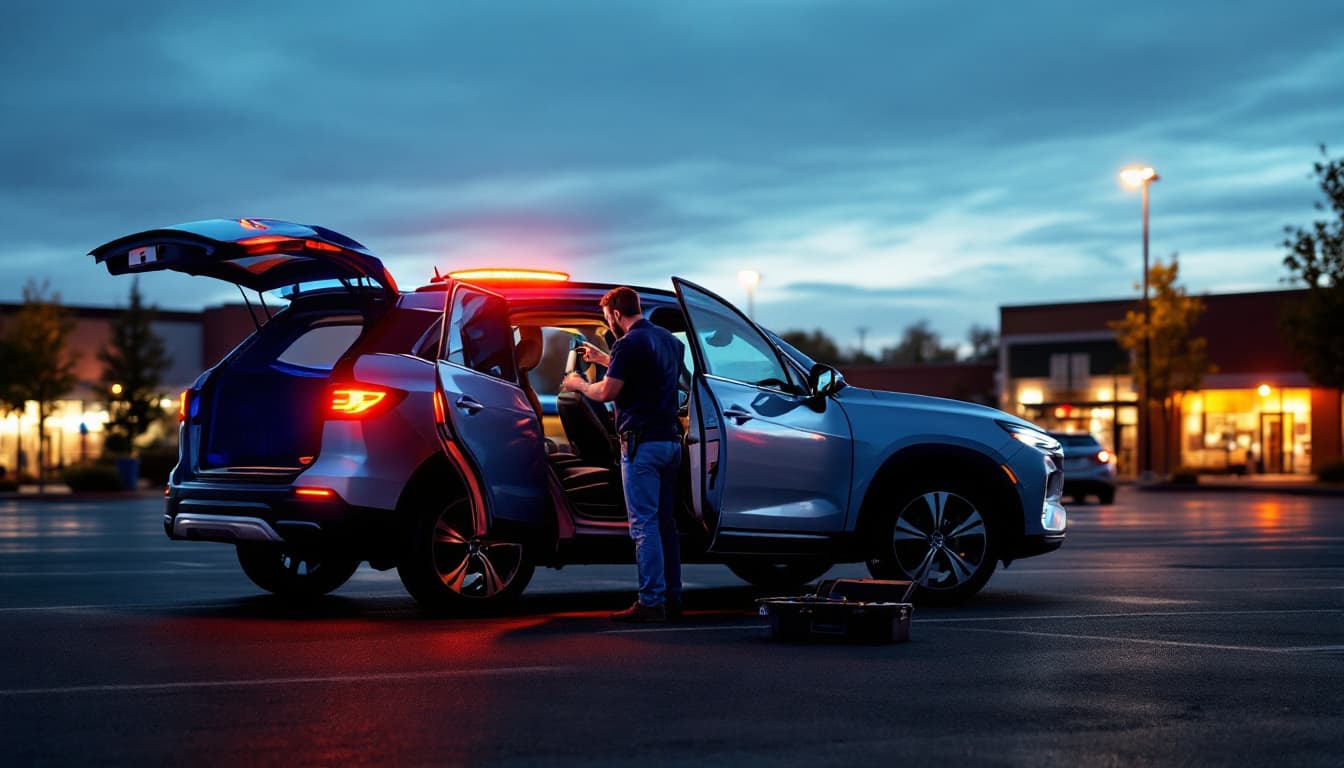
If you've lost your only key to a Kia Telluride or Sorento in Fort Worth, call a mobile automotive locksmith — the vehicle stays where it is, and expect roughly $270 to $650 all in, completed in sixty to ninety minutes. As of July 2026, that figure is the smart proximity fob at $220 – $450 plus the all-keys-lost surcharge of $50 – $200 for decoding the lock and reaching the immobilizer with no working credential to authenticate against. A bladed-key Sorento trim lands lower. Call or text 817-674-2304.
You don't need a tow. You don't need a dealership appointment three days out. What you need is the vehicle's VIN, proof it's yours, and about an hour and a half. Here's exactly how it goes.
The First Ten Minutes: Do These Four Things
1. Actually confirm the key is gone. Check the ignition-adjacent spots people lose keys: the cupholder, a coat pocket, the diaper bag, the gym locker, the restaurant table you just left. A meaningful share of all-keys-lost calls end with the key turning up mid-visit. No embarrassment in it — but it's worth five minutes.
2. Check whether the fob is merely dead rather than lost. If you have the fob but the SUV won't respond, hold it against the START button and press. Kia's push-button systems support a low-power induction read for dead fob batteries. If it starts, you need a coin cell, not a locksmith.
3. Note where the vehicle is and whether it's safe. A driveway or an office lot is fine to leave overnight. A tow-away zone, a garage that closes at 10 p.m., or an unlit lot changes the urgency. Tell us at the call.
4. Find the VIN. Through the windshield at the base of the driver's side, or on your insurance card and registration. The VIN determines the exact fob part number, the blade profile, and the immobilizer generation — everything we need to bring the right parts on the first trip.
What It Costs in Fort Worth
From the typical Fort Worth ranges published on our car key replacement cost page.
| Situation | Typical Fort Worth range | Notes |
|---|---|---|
| Smart proximity fob (push-to-start Telluride/Sorento) | $220 – $450 | The fob itself, plus cutting the emergency insert blade |
| Standard transponder chip key | $130 – $220 | Bladed-key Sorento trims |
| Remote head key | $160 – $260 | Bladed key with integrated remote buttons |
| All-keys-lost surcharge | +$50 – $200 | Decoding the lock and immobilizer access with no working key |
| Second key programmed same visit | Fob cost only | The trip and the session are already paid for — do this |
These are typical Fort Worth ranges, not a guaranteed quote. The single best financial decision available to you at this moment is the last row: have a second key programmed during the same visit. You will never pay the all-keys-lost surcharge on this vehicle again, and the marginal cost is the fob alone.
Why All-Keys-Lost Costs More Than a Spare
It's not a penalty. It's a different job.
With a working key, the vehicle authenticates and accepts a new registration in a routine diagnostic session — fifteen or twenty minutes of programming and you're done. With zero keys, there is no credential to authenticate against, which means:
- Entry has to be gained without a key and without damage
- The blade profile has to be derived from the vehicle's factory key code or by decoding the driver's door lock, rather than copied
- The immobilizer has to be reached without an existing credential, and the security system enforces a wait period on-site that nobody can shorten
- The whole registered key list often has to be rebuilt rather than appended to
Same fob, same SUV, roughly double the work. The general version of this process across other makes is in our lost car key with no spare guide.
The Timeline, Step by Step
Arrival and ownership verification — 10 minutes. Texas locksmith work is regulated under the Texas Department of Public Safety Private Security Program, established in Chapter 1702 of the Texas Occupations Code. The technician confirms current registration or title in your name against a matching government photo ID. This is not bureaucracy — it is the only thing standing between your Telluride and someone who wants a key to it. A company that skips this step is a bigger problem than the price.
Entry — 5 to 15 minutes. With no key and no cut emergency blade, opening the vehicle is a professional job with proper tools. Improvised methods on a modern three-row SUV damage weather seals, window regulators, and side-impact sensors — repairs that cost several times the lockout.
Deriving and cutting the blade — 10 to 15 minutes. The emergency insert profile comes from the factory key code by VIN or by decoding the door lock, then it's milled.
Immobilizer access and programming — 30 to 60 minutes. The security PIN for the vehicle is retrieved, the module is put into programming mode, and the new fob is registered. Much of this window is the vehicle's enforced security wait. The technician isn't idle; the SUV is deliberately stalling, exactly as designed.
Verification — 10 minutes. Push-button start tested, doors and power liftgate confirmed, panic and remote start where equipped, fault codes cleared and re-read.
Total: sixty to ninety minutes on-site. Longer if the vehicle's 12-volt battery is weak, because a programming session holds modules awake and a marginal battery can drop the session partway through.
Have This Ready Before the Technician Arrives
Getting these together while you wait shortens the visit:
- Current Texas registration or the title in your name. Bought recently? The signed title or bill of sale plus the prior registration works.
- Government photo ID matching the ownership document.
- The VIN.
- Any key you think is dead. A fob with a flat coin cell may still hold a valid credential, and if it does, this stops being an all-keys-lost job and the price drops. Genuinely check the junk drawer.
- An honest count. If the dealership handed you two fobs and you only ever saw one, say so.
What If the Vehicle Won't Wake Up At All?
Occasionally a Telluride or Sorento with a lost key also has a flat 12-volt battery — often because the SUV has been sitting untouched for weeks while the owner sorted out the key situation.
That combination has to be handled in order. The 12-volt runs the door locks, the body electronics, and the diagnostic port. Nothing can be programmed on a vehicle that has no power to the port. If the battery is flat, it gets charged or supported first, and if it's genuinely failed, it gets replaced before the key work begins.
Tell us on the call if the SUV has been sitting, if the dome lights are dim, or if nothing at all responds. It changes what the technician brings and prevents a wasted trip.
Newer Model Years and Honest Limits
Manufacturers keep tightening access to immobilizer programming, and Kia is no exception. On most Telluride and Sorento model years, all-keys-lost work is routine field work. On the newest years, security gateway requirements can put certain procedures behind manufacturer-authorized access only.
We check your specific year against what's actually achievable before dispatching a technician. If your vehicle falls on the wrong side of that line, you'll hear it on the phone rather than after paying a trip charge. That same feasibility question applies across the Hyundai and Kia family and is covered in more depth on our module programming page.
Then Do the One Thing That Prevents a Repeat
Once you have a working key again, get a second one. Not eventually — during the same visit, while the technician is standing there and the immobilizer session is already open.
The math is not close. A spare programmed alongside the first key costs the fob. A spare programmed as a separate appointment later costs the fob plus a trip. And a lost key with no spare costs the fob plus the surcharge plus whatever the disruption costs you — which, on a family SUV, is usually more than the key. Our spare car key guide lays it out across makes.
Store the spare somewhere that isn't the same keyring, the same bag, or the same coat as the primary. A key that lives in the same pocket as the key it's backing up isn't a spare.
Serving Fort Worth and Tarrant County
All-keys-lost calls come to us from all over the metro — Alliance and far north Fort Worth, the Stockyards, downtown, the medical district, TCU and the near south, Ridgmar and the west side, Wedgwood and the southwest — plus Arlington, Keller, North Richland Hills, Hurst, Bedford, Euless, and Haltom City. Full coverage on our service areas page.
These are treated as priority calls, not scheduled work — a driver with no key is stranded, and after-hours dispatch runs through our 24-hour locksmith line. If you're locked out but the key is somewhere inside the vehicle, that's a faster and cheaper call: see locked keys in car.
Why the Paperwork Step Exists (and Why You Want It To)
Standing in a parking lot with no key, being asked for a registration card feels like the last thing you need. It's also the step that means nobody else can do to your Telluride what you're currently asking a stranger to do.
Two verification systems sit behind that request. Texas licenses locksmith companies and individual technicians through the Texas Department of Public Safety Private Security Program, authorized under Chapter 1702 of the Texas Occupations Code. Separately, the manufacturer data a technician needs — key codes, security PINs, immobilizer access — is released through the National Automotive Service Task Force's Vehicle Security Professional registry and its Secure Data Release Model.
Per NASTF's Secure Data Release Model, access to key programming and immobilizer functions is granted only after business validation, criminal background checks, confirmation of professional standing, and documented proof of the vehicle owner's authority — with transactions monitored for unusual activity. — NASTF VSP Registry (SDRM)
The registry was founded in 2008 and now includes more than 9,000 NASTF participants. Getting credentialed requires business registration documents, a driver's license, a locksmith license, and consent to a background check, with a typical approval window of three to ten days. Trade certification runs through ALOA, the Associated Locksmiths of America.
An all-keys-lost job is the highest-trust work in the trade: the technician opens a vehicle they've never seen and gives someone the ability to start it. The ownership check is the entire safeguard. A company willing to waive it for you would waive it for anyone.
Does any of it work?
Measurably. The National Insurance Crime Bureau reports U.S. vehicle thefts fell 23.2% from 2024 to 2025 — from 850,708 to 659,880, the lowest levels in decades — based on reports entered into the FBI-managed National Crime Information Center database. Immobilizer systems and controlled key-data access are a substantial part of that decline.
There's one more federal layer worth knowing while you wait. FMVSS 114, the theft-protection and rollaway-prevention standard administered by NHTSA, requires that a vehicle's starting system prevent engine activation and prevent steering or forward self-mobility whenever the key is removed (NHTSA, FMVSS No. 114). That standard is why your keyless SUV is genuinely immobile right now rather than merely inconvenient — and why the fix is a programming session rather than a workaround.
One document warning, because it derails more all-keys-lost calls than anything else: if you bought the Telluride or Sorento privately and never finished the title, the technician still needs something that ties you to the vehicle. The Texas Department of Motor Vehicles requires titling in the buyer's name within 30 days of the sale date, with delinquent-transfer penalties after. A signed title with the seller's registration works at the appointment; nothing at all does not.
On pricing, the standard we hold to is a real range quoted against your VIN before anyone is dispatched. The Federal Trade Commission's advertising guidance treats advertised prices that aren't genuinely available as deceptive, and in an emergency the classic version of that is a low phone number that becomes a much larger one once a technician is standing at your window.
Frequently Asked Questions
I lost my car key and have no spare in Fort Worth. What do I do and how much will it cost?
Call a mobile automotive locksmith — the vehicle doesn't move. For a push-to-start Kia Telluride or Sorento, expect roughly $270 to $650 all in as of July 2026: $220 – $450 for the smart fob plus a $50 – $200 all-keys-lost surcharge. Bladed-key trims cost less. Have the VIN, your registration or title, and a matching photo ID ready.
How long does an all-keys-lost Kia key take?
Sixty to ninety minutes on-site. Roughly a third of that is the vehicle's enforced security wait before the immobilizer will accept a new credential — a deliberate anti-theft delay that no equipment can shorten.
Do I need to tow my Kia to the dealership if I lost every key?
No. Entry, blade cutting, immobilizer access, and key registration are all performed where the vehicle is parked. Towing to a dealership adds cost, delay, and an appointment on their schedule rather than yours.
What proof of ownership do I need for a lost Kia key?
Current Texas registration or the certificate of title in your name, plus a matching government photo ID. If you bought the SUV recently, the signed title or bill of sale with the prior registration works. Texas locksmith work is regulated under the DPS Private Security Program and this verification is required.
Can you program a second Kia key during the same visit?
Yes, and you should. The trip and the programming session are already paid for, so a second key costs the fob alone — and it means you'll never face the all-keys-lost surcharge on this vehicle again.
My Kia fob might just have a dead battery. How do I tell?
Hold the fob against the START button and press it. Kia's push-button systems support a low-power induction read specifically for dead fob batteries. If the SUV powers up, replace the coin cell rather than calling about a lost key.
Will a new key stop the lost key from working?
It can, and on an all-keys-lost job it generally does, because the registered key list is rebuilt rather than appended to. That's the security benefit of the job: whoever finds the lost fob can't use it.
Are the newest Telluride and Sorento years harder to program?
Some are. Security gateway requirements on the newest model years can restrict certain procedures to manufacturer-authorized access. We check your specific year before dispatching a technician so you're not paying a trip charge to find out.
Call Before the Lot Closes
Every hour a keyless Kia sits somewhere it shouldn't makes the situation worse — parking enforcement, a garage that locks at closing, a lot that tows overnight. The job itself takes ninety minutes and doesn't require the SUV to move an inch.
Call or text 817-674-2304 with your year, model, VIN, and where the vehicle is sitting. We'll confirm the exact fob, quote the real range before dispatch, and tell you honestly if your model year is one that needs a dealer. Mobile service across Fort Worth and Tarrant County — and if you're at a stranger's mercy in an unlit lot right now, say that first.
Article written by the Fortworthlocksmithexperts Automotive Locksmith Team. For mobile automotive locksmith service throughout Fort Worth and Tarrant County, contact us at 817-674-2304.
Locked out or need a key now?
Mobile auto locksmith service across Fort Worth and the surrounding metroplex. We come to you — 24/7.
Call 817-674-2304