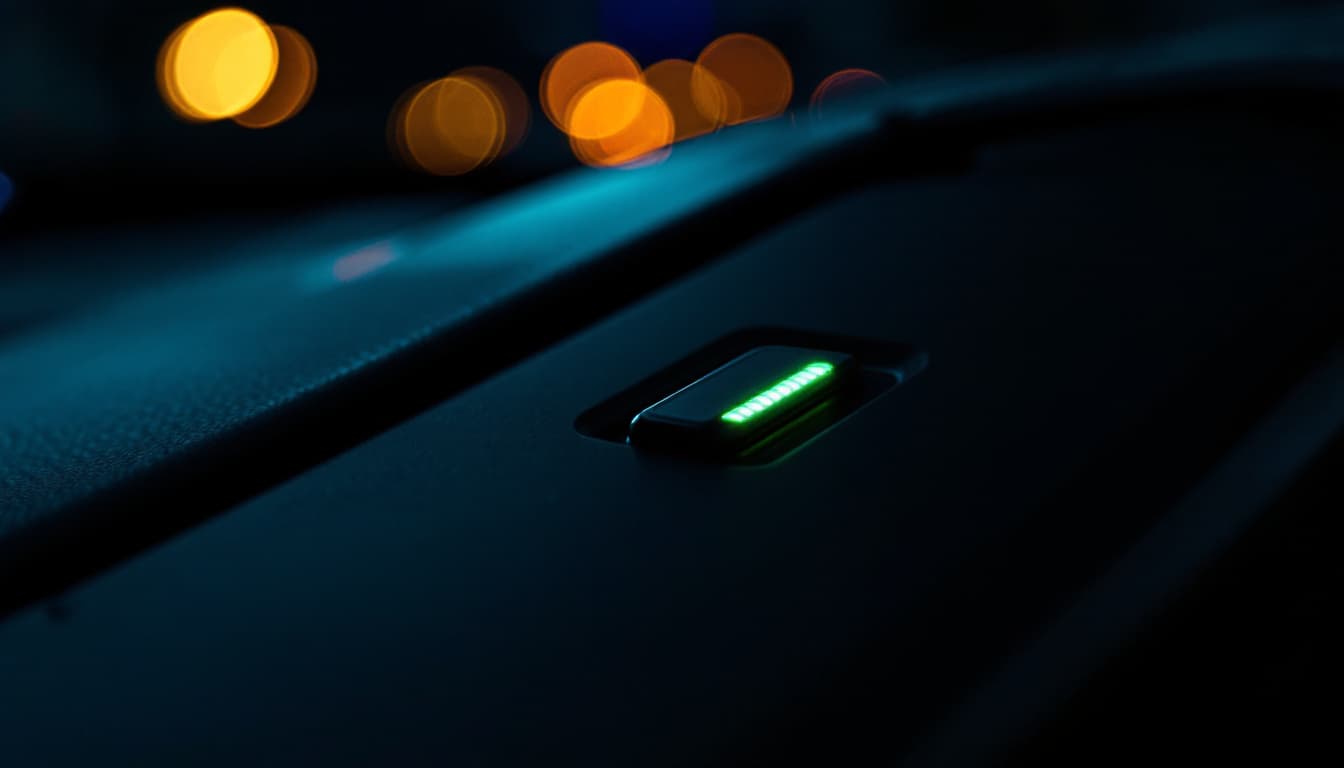
As of September 2026, the small green key icon on a Honda or Acura dashboard is the immobilizer reporting whether it recognised your key — and a blinking one means it did not. That single distinction routes the whole diagnosis: a light that goes out means the key was accepted and your problem is elsewhere in the car, while a light that keeps blinking means the security system refused to authorise a start, which is a key, antenna or module question. Call or text 817-674-2304 with your year and model and what the light is doing, and we will tell you which of those three it is likely to be.
The Three States, and What Each One Names
| What the green key icon does | What the immobilizer is saying | Where to look |
|---|---|---|
| Comes on with the ignition, then goes out | Key recognised, authorisation granted | Not a security fault — look at battery, starter, fuel |
| Blinks and keeps blinking | Key not recognised, start refused | The key, the receiver antenna, or the module |
| Stays on solid, or behaves erratically | System fault rather than a rejected key | Wiring, module, or an aftermarket device |
| Never appears at all | Bulb, cluster or power problem | Verify the cluster lights at all |
Ten seconds of watching the cluster at key-on separates "the car will not start" into two entirely different repair paths. Do that before anything else, because the two paths do not overlap at all.
Why Honda and Acura Give You This Light
Honda's immobilizer arrived across the range from the late 1990s onward and works the way most do: a transponder in the key head, a receiver coil arranged around the ignition or — on push-button cars — antennas distributed through the cabin, and a control function that compares the key's identity against what the vehicle has registered. Acura, as Honda's luxury division, uses the same architecture with its own trim.
The security value is not cosmetic. Research from the Insurance Institute for Highway Safety and its affiliated Highway Loss Data Institute has consistently found immobilizer-equipped vehicles are stolen at lower rates than comparable vehicles without them, which is exactly why the system refuses rather than negotiates when it does not recognise a credential.
The green icon is the part of that conversation you can see.
Step One: Try the Other Key
If a second working key exists, this is the highest-value thirty seconds available.
Second key works normally. The vehicle is fine. The first key has failed — a cracked transponder, a broken solder joint inside a remote head, water damage, or simple age. Replacing one key is ordinary work.
Second key blinks the same way. The vehicle side is the suspect. Two independently failed keys is possible but unusual; a single failed receiver looks exactly like this and is far more likely.
That one test does more than any amount of guessing, and it is the first thing a good shop will ask about on the phone.
Step Two: Rule Out Power
A low 12-volt battery produces a remarkable range of misleading security behaviour. Modules brown out, the receiver does not wake cleanly, and a car that is simply low on volts throws warnings that look like theft-system faults.
Before concluding anything from a blinking key light, confirm the battery is healthy — not merely capable of lighting the dash, but actually charged. If the vehicle has been jumped, has sat, or has a battery over about four years old, resolve that first and re-test. We wrote the longer version of that ladder in the car sat for three weeks and now the key does nothing.
Programming also requires stable voltage, so this order matters even when a new key is the eventual answer: battery first, keys second.
Step Three: Look for an Aftermarket Alarm or Remote Starter
Fort Worth has a large population of Civics, Accords, CR-Vs and TLs that have changed hands several times, and remote starters and aftermarket alarms are common on all of them — frequently installed by a previous owner and not mentioned to anyone since.
These devices are spliced into the ignition and immobilizer circuits, usually with a bypass module that stores a key credential so the car can start without a person present. When the bypass fails, or a connection corrodes, the symptom is precisely what you are seeing: the car cranks, the green key light blinks, and nothing authorises.
Look under the dash on the driver's side for a bundle of wires wrapped in tape that does not look like factory loom, or a small black box cable-tied behind the kick panel. If you find one, mention it when you call. It changes the diagnosis and sometimes it is the diagnosis.
Step Four: The Receiver Antenna
On key-in-ignition Hondas and Acuras, the transponder is read by a coil sitting around the ignition cylinder. It is a small, hardworking component in a place that gets handled thousands of times, and when it fails the vehicle stops being able to read any key at all.
The signature: every key blinks the light, all of them at once, usually with no warning beforehand. Sometimes it is intermittent first — works cold, fails warm, or the other way round — which is why a car that started this morning and refuses this afternoon is not a contradiction.
On push-button Hondas and Acuras the equivalent components are the cabin antennas and the receiver module. The symptom set is the same, plus messages about the smart-entry system on the driver's display.
Either way, this is a diagnosis to make with equipment rather than by elimination, because a receiver fault and a dead key look identical from the driver's seat.
Step Five: Has Anything Been Replaced Recently?
One specific history changes everything: a replaced engine controller.
On these vehicles the immobilizer function is tied to the engine control module, and a replacement module — whether new, remanufactured or pulled from another car — does not arrive knowing your keys. It must be registered to them. Until that happens the car cranks and the green light blinks, no matter how good the keys are.
If your Honda or Acura recently had a PCM, ECM or ignition-switch job and this began immediately afterwards, that sequence is almost certainly the cause. The work involved is described on our Honda immobilizer control unit and PCM programming page.
While you are checking history, it is worth running the VIN through the National Highway Traffic Safety Administration recall lookup. It takes a minute and occasionally explains an electrical symptom nobody had connected to anything.
What the Light Cannot Tell You
Two honest limits, because the icon gets over-read.
A blinking key light does not mean the key is lost from memory. Credentials are held in non-volatile memory. A key does not un-programme itself sitting in a pocket. It can fail physically, and the vehicle can lose the ability to read it, but the registration does not evaporate.
A green light that goes out normally means the security system is satisfied — and nothing else. If the car then cranks without starting, you have a fuel, spark or mechanical problem and the immobilizer has already done its job correctly. Continuing to chase keys at that point is a way to spend money without fixing a car.
What It Costs When It Is the Key
Honda and Acura keys span several bands depending on age and trim. These are our published Fort Worth figures from the car key replacement cost page, complete job, parts and programming included:
| Key type | Complete job |
|---|---|
| Basic mechanical key (pre-immobilizer) | $50 – $100 |
| Standard transponder chip key | $130 – $220 |
| Remote head key | $160 – $260 |
| Flip key | $170 – $290 |
| Smart proximity fob (push-to-start) | $220 – $450 |
| Luxury / European smart key | $300 – $700+ |
| All-keys-lost surcharge | +$50 – $200 |
Roughly speaking: an older Civic, Accord, Element or CR-V with a bladed key sits in the transponder or remote-head rows; a modern Accord, CR-V, Pilot, MDX, RDX or TLX with push-button start sits in the smart-fob row. Model-specific detail for the two most common cases is in Honda Civic transponder and smart key replacement, Honda CR-V 2017-2026 all keys lost and Acura MDX all keys lost.
If the diagnosis lands on the receiver or the module rather than the key, that is a different job with a different number, and we will say so rather than selling you a key that will blink exactly like the last one.
The Order We Work It
For anyone who wants to know what happens when we arrive:
- Verify ownership. Registration or title plus photo ID before anything is touched. This is the standard the National Automotive Service Task Force applies through its Secure Data Release Model, under which independent technicians are identity-vetted before manufacturers release key and security data. A shop that skips it is a problem waiting to happen.
- Check voltage. Nothing below is trustworthy on a weak battery.
- Read the module. How many keys are registered, what the system reports, and whether the receiver is seeing anything at all when a key is presented.
- Test each key you have. Including the ones in the kitchen drawer — bring them.
- Then decide. Key, receiver, wiring, module or aftermarket device. Only one of those five is a key job.
That sequence is the difference between a diagnosis and a guess, and it is quick.
Five Facts to Have Ready Before You Call
This diagnosis is unusually phone-friendly, because the useful information is all observable from the driver's seat. Have these five ready and most calls resolve to a confident answer before anyone dispatches:
- Year and model. A 2006 Civic and a 2020 Civic share a nameplate and almost nothing else that matters here.
- What the light does. Comes on and goes out, blinks and keeps blinking, stays solid, or never appears. These are four different problems.
- What the second key does. The single most diagnostic fact available, and it costs thirty seconds to establish.
- What changed recently. A new battery, a jump start, a replaced engine computer, an ignition job, a windscreen, a stereo. Immobilizer faults that begin the day after work was done are usually related to the work.
- Whether there is anything aftermarket under the dash. Remote starter, alarm, tracker. Say so even if you inherited it and have never used it.
A shop that takes those five and still cannot tell you what it expects to find is guessing, and guessing is expensive on a security system.
A Word on Who You Call
Texas regulates locksmiths through the Texas Department of Public Safety Private Security Program — not TDLR, which is a common mix-up. Ask for the company licence number; it takes two minutes to verify.
Both the Federal Trade Commission and the Better Business Bureau publish consumer warnings about locksmith call centres that advertise a national headline price and dispatch an unknown local subcontractor. On an immobilizer fault specifically, the risk is not only the price — it is somebody working inside a security system they do not understand and leaving you with a car that starts less reliably than it did this morning.
Mobile Service Across Fort Worth and Tarrant County
We diagnose and program at the vehicle, which matters here because a car with a blinking key light frequently cannot be driven to anyone. That covers Fort Worth and the surrounding Tarrant County cities including Arlington, Hurst, Bedford, Euless, Haltom City, Keller and North Richland Hills.
Everything we do for the brand sits on the Honda key replacement page, and the programming service itself is described under key fob programming.
Frequently Asked Questions
What does a blinking green key light mean on a Honda?
It means the immobilizer did not recognise the key presented and has refused to authorise a start. The cause is the key itself, the receiver antenna that reads it, the control module, or an aftermarket device spliced into those circuits. A light that comes on and then goes out means the key was accepted.
Is the green key light the same as the security light?
On Honda and Acura the green key-shaped icon is the immobilizer indicator specifically. Other manufacturers use a red padlock or a car-and-key symbol for the same function. The behaviour to read is the same everywhere: illuminated briefly then out is normal, persistent blinking is a refusal.
My Honda cranks but will not start and the key light blinks. Is it the key?
Not necessarily. Try a second key first — if it works, the first key failed; if it blinks identically, suspect the receiver antenna, the module or an aftermarket alarm bypass. A weak battery can also produce this, so confirm voltage before concluding anything.
Can a Honda key lose its programming?
No. The credential is stored in non-volatile memory on both sides and does not erase itself over time. Keys fail physically — cracked transponders, broken solder joints, water damage — and vehicles lose the ability to read them, but the registration does not evaporate on its own.
Why did my key stop working right after an engine computer replacement?
Because the immobilizer function is tied to the engine control module, and a replacement module does not arrive knowing your keys. It has to be registered to them. Until that registration is done the car will crank and the green key light will keep blinking regardless of key condition.
Could my remote starter be causing the immobilizer light?
Yes, and on older Fort Worth Hondas and Acuras it is a common cause. Aftermarket starters and alarms use a bypass module that stores a key credential, and when that module or its connections fail the car cranks without authorising. Look under the driver's side dash for non-factory wiring and mention it when you call.
Does a blinking key light mean I need a new ignition switch?
Not by itself. The receiver coil that reads the transponder sits around the ignition on key-in-ignition models, so a failure there is often described loosely as an "ignition" problem, but the mechanical cylinder and the electronic receiver are different parts with different prices. A proper diagnosis separates them.
How much does it cost to fix on a Honda or Acura in Fort Worth?
If the answer is a key, expect the transponder or remote-head band of $130 – $260 on older models and the smart-fob band of $220 – $450 on push-button models, with $50 – $200 added if every key is lost. Receiver or module faults are priced separately once diagnosed.
Tell Us What the Light Is Doing
It is the most useful sentence you can open a call with.
Call or text 817-674-2304 with your year, model, whether the green key icon blinks or goes out, and whether a second key behaves the same. We will tell you what we expect to find before anyone drives to you — including when what you need is a mechanic rather than a locksmith.
Article written by the Fortworthlocksmithexperts Automotive Locksmith Team. For mobile automotive locksmith service throughout Fort Worth and Tarrant County, contact us at 817-674-2304.
Locked out or need a key now?
Mobile auto locksmith service across Fort Worth and the surrounding metroplex. We come to you — 24/7.
Call 817-674-2304