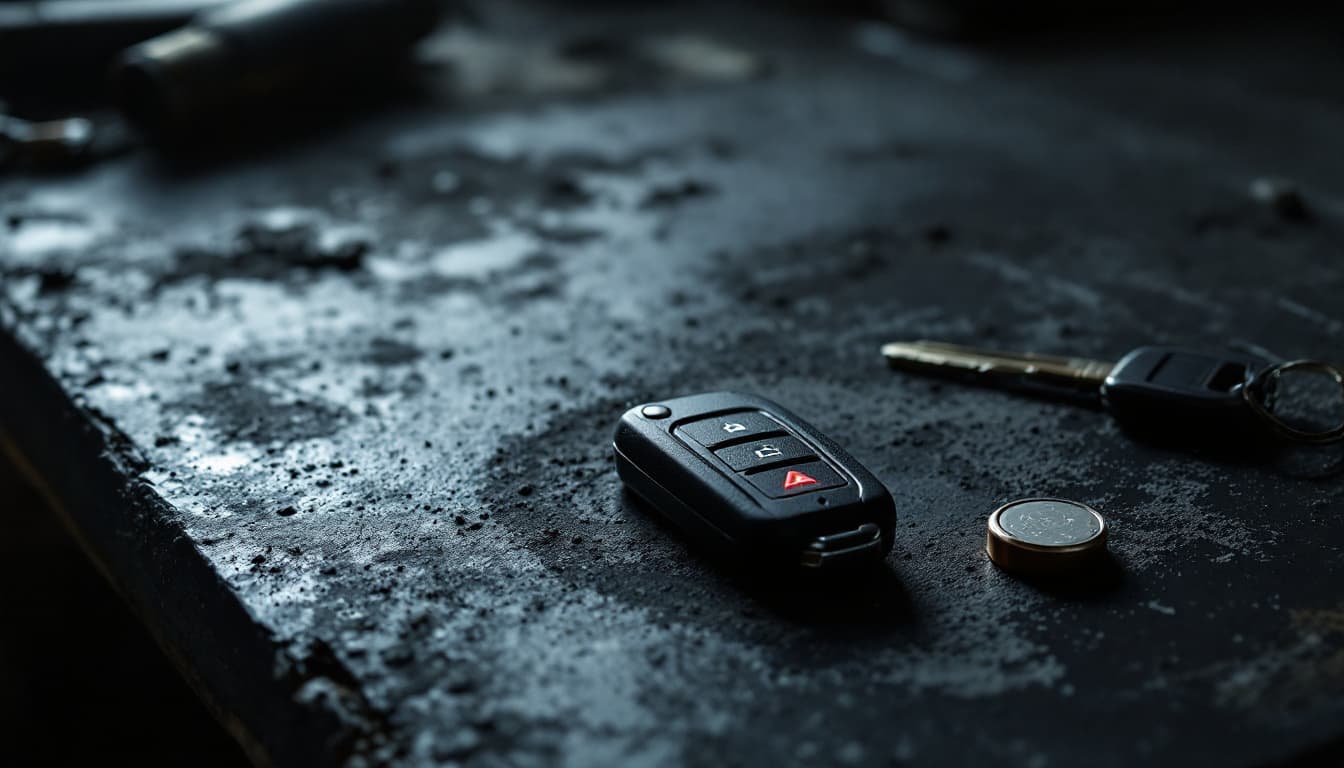
As of September 2026, a car that worked fine when you parked it and ignores the key three weeks later is almost never a key problem. The overwhelming majority of these are the vehicle's own 12-volt battery sitting below the voltage its receiver needs to wake up, followed by a fob coin cell that quietly ran down while nothing was using it. Both are settled in the car park in about ten minutes, and neither one requires a new key. Call or text 817-674-2304 if you get to the end of the ladder below and the car still will not respond.
The Five Causes, in the Order They Actually Happen
| Cause | What you see | Where it ranks |
|---|---|---|
| Vehicle 12V battery below wake threshold | Nothing responds — no chirp, no dome light, or a very dim one | Most cases |
| Fob coin cell exhausted | Car responds to nothing from the fob, but the interior lights work | Common |
| Heat damage to the fob | Fob left inside the car through a Texas summer | Seasonal |
| Ignition cylinder or steering lock seized | Blade goes in, nothing turns | Occasional |
| Rodent damage to wiring or antenna | Intermittent nonsense, sometimes other faults too | Rare but real |
Notice what is not on that list: the key losing its programming. Transponder and smart-key credentials are stored in non-volatile memory on both sides. They do not evaporate because the car sat. If someone tells you the key "lost its code" from sitting, ask for a second opinion.
Step One: Get Inside Without the Fob
Before diagnosing anything, get the door open, because half the information you need is inside the car.
Nearly every proximity fob contains a mechanical emergency blade — a small release on the fob body slides it out. On many vehicles the driver's door keyhole is hidden behind a plastic cap on the handle, and prising that cap off with the blade is normal, intended and slightly alarming the first time.
Expect the alarm to sound when you open a door this way. On most vehicles that is correct behaviour, not a fault — the car sees a door opening without a recognised credential nearby. It usually stops once the ignition is switched on or the car recognises the key.
If the blade will not turn in a lock that has been sitting through Texas humidity, stop forcing it. A snapped blade inside a door lock converts a ten-minute problem into an extraction job, which we describe on the car lockout page.
Step Two: Read the Dome Light
With a door open, look at the interior lighting. This one observation splits the diagnosis in half.
Lights are bright and normal. The vehicle's battery is probably fine, which points at the fob. Go to step three.
Lights are dim, orange, flickering, or completely absent. The vehicle's battery is the problem, and the fob is a bystander. Go to step four.
Everything is normal and the car starts the moment you press the button while holding the fob against it. That is the vehicle's backup coupling working correctly — the fob's battery is dead and the car read the transponder by proximity instead. You need a coin cell, not a key.
Step Three: The Fob's Coin Cell
A fob is never truly idle. It listens, and on proximity systems it periodically announces itself to the car, which is why a smart fob left in a handbag drains faster than a basic remote left in a drawer. A cell that had months left in it in June can be finished by the time you come back from a long trip.
Heat accelerates it. The National Weather Service forecast office that covers Fort Worth tracks the region's triple-digit stretches every summer, and the inside of a closed car in a long-stay car park runs far hotter than the air outside. A fob left in a cupholder through that is a different proposition from one that travelled with you.
Replace the cell with a fresh one of the correct type — the number is printed on the old cell — from a source with turnover. Coin cells sitting on a shelf for years arrive partly depleted, which produces the specific frustration of a "new" battery that changes nothing.
If a genuinely fresh cell changes nothing, the fault is further up. We wrote the full ladder for that case separately in I changed the key fob battery and it still does not work, which is the natural next stop.
Step Four: The Vehicle's 12-Volt Battery
This is the big one, and it is worth understanding why it produces such a strange symptom.
A modern car does not switch off when you remove the key. Alarm, body module, telematics, remote services and the receiver listening for your fob all keep drawing a small current continuously. Over weeks that draw adds up, and a battery that was merely middle-aged when you parked can drop below the level the electronics need.
The confusing part is the order things fail in. Well before a battery is too weak to crank the engine, it is too weak to run the security electronics reliably. So the car can have enough energy to glow a dome light and still ignore every button on the fob, because the receiver and body module never wake properly. Owners read that as "the key stopped working" when the car simply is not listening.
Two rules for this stage:
Do not keep cranking. Repeated attempts on a low battery drag voltage further down and can make the car behave stranger still — warning lights, phantom faults, modules dropping off the network.
Charge rather than crank, where you can. A proper charge restores a depleted battery far more kindly than a jump followed by an idle. If the battery is several years old and has now been deeply discharged, it may not recover, and replacing it is the honest fix.
One consequence worth knowing before anybody visits: key programming requires stable voltage. If a technician arrives and the battery is flat, the sequence has to be battery first, keys second. A programming session interrupted by voltage collapse is exactly the situation nobody wants, which is why a good shop asks about the battery on the phone.
Step Five: The Key Goes In and Nothing Turns
On a bladed-ignition vehicle that has sat for a long time, a different failure appears: the blade inserts normally and will not rotate.
Usually this is the steering lock loaded against the column. The wheel is holding a pin under tension, and the cure is to apply firm steady pressure to the wheel in both directions while turning the key gently. It frees with a small click far more often than people expect.
When it is not that, it is the cylinder itself: wafers gummed with old lubricant and dust, sometimes light corrosion after months of humid Fort Worth air. That is mechanical work rather than key work, and it is covered on our ignition repair page. A worn key and a worn cylinder also conspire — a blade that had become marginal before you parked can tip over the edge after a long sit, which is a separate diagnosis we walk through in the key will not go into the ignition.
What not to do: do not apply force through a screwdriver or pliers. A cylinder that needs replacing costs what it costs. A cylinder that has been forced also needs a new key, and sometimes a new housing.
Step Six: The Uncommon One — Something Lived in the Car
Vehicles parked for long stretches in Texas occasionally acquire tenants. Rodents nest in warm engine bays and chew wiring, and the harness runs that feed antennas and body modules are as available as anything else.
The signature is inconsistency. A car whose battery and fob both test fine, which responds sometimes and not others, or which has picked up unrelated electrical faults while standing still, is worth a look with the bonnet up before anyone assumes the key is at fault. Look for shredded insulation, nesting material on top of the battery tray, and the smell.
This is a repair-shop job rather than a locksmith one, and we will tell you if that is where the evidence points.
What This Costs
In the common cases, very little. A coin cell is a few dollars. A vehicle battery is a parts-store purchase. Neither requires a locksmith.
Where a genuine key job does emerge — a fob damaged by heat inside the car, a blade that broke off in a stiff lock, a cylinder that has reached the end — these are our published Fort Worth bands from the car key replacement cost page:
| Key type | Complete job |
|---|---|
| Basic mechanical key (pre-immobilizer) | $50 – $100 |
| Standard transponder chip key | $130 – $220 |
| Remote head key | $160 – $260 |
| Flip key | $170 – $290 |
| Smart proximity fob (push-to-start) | $220 – $450 |
| Luxury / European smart key | $300 – $700+ |
| All-keys-lost surcharge | +$50 – $200 |
The reason we lead with the free checks rather than the table is simple: most of these calls end with a battery, and telling you that on the phone costs us a job and keeps a customer.
If You Park Something Long-Term on Purpose
Fort Worth has a lot of vehicles that sit by design — a second car, a truck between seasonal jobs, a student's car over a semester, anything left at long-stay parking while its owner is elsewhere.
Three habits remove nearly all of this:
Drive it occasionally. Twenty minutes of genuine driving every couple of weeks does more for a battery than any amount of idling.
Use a maintainer if it sits longer. A trickle maintainer on a garaged vehicle is the difference between a car that starts in March and a battery that needs replacing.
Take the fob with you, and keep a spare that works. The fob is safer with you than baking in a cupholder. And a vehicle with exactly one key is one loss away from an all-keys-lost job — the arithmetic on that is in spare key now vs all keys lost later.
When to Stop and Call
Call when the car has a healthy battery, a fresh fob cell, and still shows no recognition — particularly if the dash displays a no-key message, which points at the receiver, the antenna or the fob's electronics rather than at power. Our no key detected page covers that specific message.
Call, too, if a blade snapped, if the cylinder will not turn after the steering-wheel trick, or if the fob has been through a genuine Texas summer inside the car and now behaves erratically rather than not at all — intermittent behaviour has its own diagnosis, which is in the key fob works sometimes.
Whoever you call, check the licence. Texas regulates locksmiths through the Texas Department of Public Safety Private Security Program — not TDLR, a common mix-up — and a technician originating a key should ask you for proof of ownership and photo ID, the same verification standard the National Automotive Service Task Force applies to secure vehicle data. The Better Business Bureau and the Federal Trade Commission both publish warnings about locksmith call centres that advertise a national headline price and dispatch an unknown subcontractor locally.
Mobile Service Across Fort Worth and Tarrant County
We come to where the car is, which for this particular problem matters — the vehicle in question frequently cannot be driven anywhere. That covers Fort Worth and the surrounding Tarrant County cities including Arlington, Hurst, Bedford, Euless, Haltom City, Keller and North Richland Hills.
Tell us on the phone what the dome light did. It is the single most useful sentence you can open with, and it often ends the call with you buying a battery instead of a key.
Frequently Asked Questions
Why did my key fob stop working while the car was parked?
Usually because the vehicle's 12-volt battery drained below the level its receiver needs to wake, or because the fob's coin cell ran down. Alarm, body and telematics modules draw current continuously, so a car left for weeks can go quiet even though it was healthy when parked.
Can a car key lose its programming if the car sits too long?
No. Transponder and smart-key credentials are stored in non-volatile memory in both the key and the vehicle, and sitting does not erase them. If a car ignores a key after a long park, the cause is power, the fob's battery, or a hardware fault — not lost programming.
My dome light works but the fob does nothing. What does that mean?
It usually points at the fob rather than the car, so start with a fresh coin cell of the correct type from a source with turnover. If a genuinely fresh cell changes nothing, the fault is in the fob's electronics, the vehicle's receiver or its antenna.
Should I jump-start a car that has been sitting for weeks?
Charging is kinder than jumping followed by idling, because a deeply discharged battery recovers better on a proper charge. Avoid repeated cranking attempts on a weak battery — low voltage can produce phantom warning lights and modules dropping off the network.
Why does my alarm go off when I unlock the door with the emergency blade?
Because the car sees a door opening without recognising a credential nearby. On most vehicles that is correct behaviour rather than a fault, and it normally stops once the ignition is on or the car recognises the key.
The key goes into the ignition but will not turn after sitting. What now?
Most often the steering lock is loaded against the column — apply firm steady pressure to the wheel in both directions while turning the key gently. If that does not free it, the cylinder itself may be gummed or worn, which is mechanical repair work rather than a key problem.
Can the locksmith program a key if my car battery is flat?
Not reliably. Programming needs stable voltage, so the correct order is battery first, keys second. A session interrupted by voltage collapse is the situation to avoid, which is why we ask about the battery on the phone before dispatching.
How do I stop this happening to a car I park long-term?
Drive it properly for twenty minutes every couple of weeks, use a battery maintainer if it sits longer than that, and take the fob with you rather than leaving it to cook inside the car. Make sure a working spare exists before you leave.
Start With the Dome Light
Most of these end without a locksmith, and that is the right outcome.
If you have worked through the ladder and the car still does not recognise a key, call or text 817-674-2304 with your year, make, model and what the interior lights did. We will tell you what we think it is before anyone drives anywhere.
Article written by the Fortworthlocksmithexperts Automotive Locksmith Team. For mobile automotive locksmith service throughout Fort Worth and Tarrant County, contact us at 817-674-2304.
Locked out or need a key now?
Mobile auto locksmith service across Fort Worth and the surrounding metroplex. We come to you — 24/7.
Call 817-674-2304