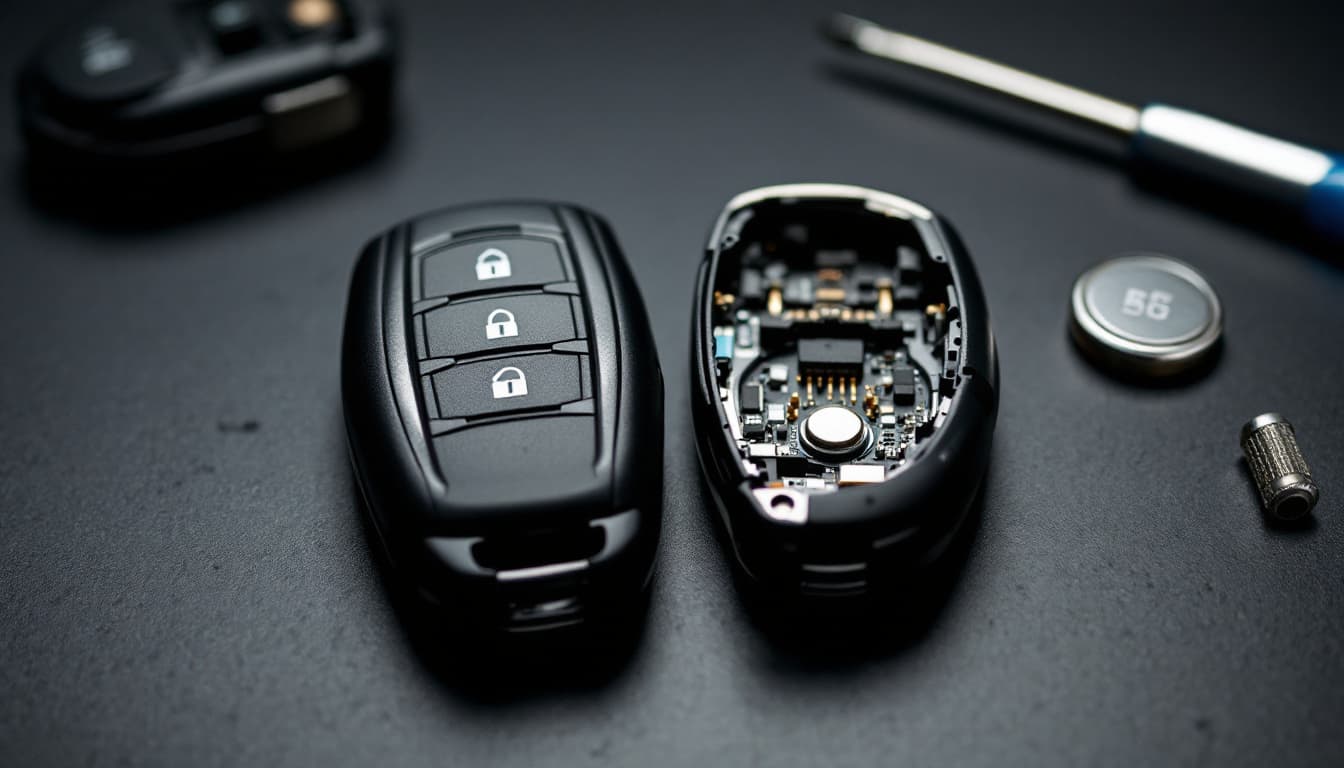
As of September 2026, a fob that stays dead after a fresh battery is most often one of three things: the wrong coin cell thickness, a contact tab bent during reassembly, or a fob that needs re-syncing after losing power — and all three are cheaper than the replacement people usually jump to. The two tests that split the problem fastest are the second-fob test and the emergency-start test, both of which take under a minute in your driveway. Call or text 817-674-2304 with your year, make and model if the ladder below runs out before the fault does.
Start Here: The Two Tests That Halve the Problem
Before opening anything, run these.
Test one — the second fob. If you have another fob, try it. If the second one works normally, the vehicle is fine and the fault lives in the first fob. If both are dead, suspicion moves hard toward the vehicle: the receiver, a fuse, or the body control module. Two independent radios do not fail on the same day.
Test two — the emergency start. On a push-to-start vehicle, hold the fob physically against the start button and press. Most platforms have a deliberate short-range backup coil for exactly this situation. If the car starts that way, the fob's transponder chip is alive and only its radio side is failing — which points at the battery circuit, not at a dead fob. Our push-to-start key page explains where that backup spot usually is by manufacturer.
Those two results narrow nine possibilities down to two or three before you have touched a screwdriver.
The Ladder, in the Order Worth Checking
| # | Cause | How you spot it | Fix |
|---|---|---|---|
| 1 | Wrong coin cell size | Fob works if squeezed; battery rattles | Correct cell |
| 2 | Battery in backwards | Nothing at all, no LED | Flip it |
| 3 | Bent or dirty contact tab | Intermittent when pressed hard | Re-tension, clean |
| 4 | Weak new battery from old stock | Worked for a day, then faded | Fresh cell, sealed pack |
| 5 | Fob needs re-sync after power loss | Everything looks right, car ignores it | Relearn procedure |
| 6 | Case not fully closed | Buttons feel spongy | Re-seat both halves |
| 7 | Cracked solder or water damage inside | Second fob works, this one does not | Fob replacement |
| 8 | Vehicle receiver, fuse or module | Both fobs dead | Vehicle diagnosis |
| 9 | It was never the fob | Fob unlocks some doors, not others | Door actuator |
1. The Wrong Battery, and Why the Number Is the Answer
This is the most common cause and the least obvious, because the battery you bought looks right.
Coin cell designations are dimensions, not part numbers. Under the IEC 60086 standard, a CR2032 is 20 mm across and 3.2 mm thick. A CR2025 is the same 20 mm across and only 2.5 mm thick. They drop into the same holder and look identical from above — but the thinner one sits 0.7 mm lower, and on a fob whose contact tab was designed for 3.2 mm, that gap is the whole problem. Squeeze the fob and it works. Let go and it does not.
CR1620, CR1632 and CR2450 appear in fobs too, and the same logic applies: first two digits are diameter, last two are tenths of a millimetre of thickness.
Check the old battery's marking, not the new one's packaging. If the old cell says CR2032 and you installed a CR2025 because the shop had those, that is your fault found.
2. Orientation, Which Sounds Insulting Until It Is You
Positive side up is correct in the large majority of fobs — but not all, and there is no universal rule. The holder is usually marked, in print small enough that reading it needs a phone camera at maximum zoom.
A fob installed backwards gives you exactly nothing: no LED flash on the button, no response at any range. If you are getting absolutely no sign of life, re-open it and check before assuming the fob is dead.
3. The Contact Tab
Most fobs hold the battery with a sprung metal tab. Prise a battery out with a screwdriver — which everyone does — and it is easy to flatten that tab slightly on the way past.
Two things to do with it. Bend it back up by a fraction of a millimetre so it presses firmly. And clean both the tab and the battery face with a dry cloth or a rubber eraser: finger oils are enough to compromise a contact carrying microamps, and handling a coin cell by its flat faces is exactly what people do.
While the case is open, look for green or white crust around the contacts. That is corrosion, usually from an old cell that leaked, and it means cleaning rather than replacing the battery.
4. The Battery Is New But Not Good
Coin cells self-discharge on the shelf. A cell from a bargain multipack that has been sitting in a warehouse for two years may read close to its nominal voltage with no load and collapse the moment the transmitter draws current.
The tell is a fob that works for a day or two and then fades again. If you are on your second dead battery in a week, buy a single sealed cell from a brand you recognise rather than another multipack.
5. Re-syncing After Power Loss
This is the one people do not know exists, and it is genuinely common.
Some vehicles use a rolling-code scheme where the fob and the receiver both advance through a sequence with every press. Lose power in the fob for long enough and the two can fall out of step; on many platforms they resynchronise automatically within a few presses, but on some the fob must be formally relearned.
Relearn procedures vary enormously — key-cycle sequences on older vehicles, an on-board menu on some, and a diagnostic-tool session on plenty of modern ones. Where it needs the tool, that is the same key fob programming work as pairing a brand-new fob, and it is much cheaper than buying hardware you do not need.
If your fob looks electrically healthy — the LED flashes when you press a button — and the car still ignores it, re-sync is where the suspicion should sit.
6. The Case Did Not Close
Many fobs rely on case pressure to hold the battery against its contact. Clip the halves together imperfectly, leave a corner proud, and you have an intermittent connection that behaves exactly like a failing battery.
Press firmly around the whole seam until you hear it seat. If the buttons feel spongier than they did before you opened it, the halves are not home.
7. The Fob Itself Has Failed
If the second-fob test says the vehicle is fine and everything above checks out, the fob has a hardware fault.
The usual ones are a cracked solder joint at the battery terminal or under a button — the result of years of being dropped and sat on — and water damage, which in this climate is usually a cycle of sweat and heat rather than a single soaking. Both are visible under magnification as dull, granular or discoloured joints.
At that point you are replacing the fob, and the cost depends far more on where the part comes from than on who programs it. We laid the four sourcing routes out in OEM vs aftermarket key fob replacement cost — and one of those routes regularly ends with a fob that cannot be paired at any price, which is worth reading before you order anything online.
8. When It Is the Vehicle, Not the Fob
Both fobs dead is the loudest signal, and it moves the job from a parts question to a diagnosis.
Three candidates. A blown fuse on the circuit feeding the keyless receiver, which is the cheapest and always worth checking first. The receiver antenna module itself, which on many vehicles lives behind interior trim and is a discrete replaceable part. Or the body control module that interprets what the receiver hears, which is the one that turns into module programming work.
There is also a fourth that is not a fault at all: local radio interference. Keyless entry shares crowded unlicensed spectrum, and a strong nearby transmitter can drown out a fob that is working perfectly. If your fob is dead in one specific parking garage or one specific spot on your street and fine everywhere else, that is not a broken fob. The FCC publishes guidance on that class of interference, and the practical test is simply to try the fob a block away.
Every certified radio device in the United States carries an FCC ID, and yours is printed on the back of the fob — searchable in the FCC equipment authorization database, which is also the number to quote if you end up ordering a replacement.
9. When the Fob Was Never the Problem
One pattern that gets misdiagnosed constantly: the fob unlocks some doors and not others, or the driver's door specifically has stopped responding while the rest of the car obeys.
A radio fault cannot be selective like that. The fob's signal reaches the vehicle or it does not. If three doors unlock and one does not, the fault is in that door's lock actuator — a small motor that wears out — and no amount of fob work will touch it.
Similarly, if the fob unlocks the car fine but the vehicle will not start and reports no key present, that is the transponder or receiving coil side rather than the remote side, and our no key detected page covers that specific failure.
The Intermittent Case Is Its Own Article
If the fob is not dead but unreliable — works from two feet, not twenty; works in the morning, not in the afternoon; works after you take the battery out and put the same one back — that is a different diagnostic path with different likely causes, and we wrote it up separately in key fob works sometimes: the intermittent fault.
Dead and unreliable are genuinely different symptoms. Treating an intermittent fault as a dead fob is how people end up buying hardware that changes nothing.
What We Check On Site
An appointment for this starts with the two tests at the top of this article, then moves to measuring the fob's battery voltage under load rather than at rest, inspecting the contacts and board under magnification, and reading the vehicle's own view of the situation through the diagnostic port — which will say whether the receiver is hearing anything at all.
That last step is what separates "your fob is broken" from "your vehicle stopped listening", and it is the difference between a $15 fix and a replacement. What happens during a mobile key fob appointment walks through the whole visit.
If a replacement genuinely is the answer, it is priced against the published Fort Worth band for your key type — $220 – $450 for a smart proximity fob and $160 – $260 for a remote head key as of September 2026 — and that is the complete job, part and programming together. Full bands are on our car key replacement cost page, and the whole service sits under key fob replacement in Fort Worth.
Mobile Service Across Fort Worth and Tarrant County
Fob work is mobile because the vehicle has to be present for anything beyond a battery — the technician comes to your driveway, workplace or wherever the car sits, across Fort Worth and the surrounding Tarrant County cities including Arlington, Keller, Hurst, Bedford and Haltom City.
If the fob turns out to be beyond saving and it was your only one, car key replacement in Fort Worth covers what that job looks like from zero.
Frequently Asked Questions
I put a new battery in my key fob and it still does not work. Why?
Most often the coin cell is the wrong thickness, the contact tab was flattened while removing the old battery, or the fob needs re-syncing after losing power. Check the old cell's marking against the new one first — a CR2025 is 0.7 mm thinner than a CR2032 and sits below the contact.
Does it matter if I use a CR2025 instead of a CR2032?
Yes. The digits are dimensions: both are 20 mm across, but a CR2032 is 3.2 mm thick and a CR2025 is 2.5 mm. The thinner cell can lose contact with the terminal, producing a fob that works when squeezed and fails when released.
Can a key fob battery be installed the wrong way round?
It can, and it produces no response at all — no LED, no range. Positive side up is usual but not universal, and the holder is marked. If there is no sign of life whatsoever, re-open the fob and check orientation before assuming the fob is dead.
Do I need to reprogram my key fob after changing the battery?
Usually not. Some vehicles use rolling codes where the fob and receiver can fall out of step after a power loss; many resynchronise within a few presses, but some require a formal relearn. If the fob's LED flashes and the car still ignores it, a re-sync is the likely answer and it costs far less than a new fob.
Both of my key fobs stopped working at the same time. What does that mean?
It shifts suspicion away from the fobs. Two independent radios rarely fail on the same day, so a fuse on the receiver circuit, the keyless receiver module or the body control module becomes more likely. Check the fuse first — it is the cheapest possibility.
My fob unlocks three doors but not the driver's door. Is the fob failing?
No. A radio signal reaches the vehicle or it does not; it cannot be selective by door. A single door that stops responding while the others obey has a failing lock actuator in that door, and fob work will not fix it.
How can I tell whether the fault is the fob or the car?
Try a second fob. If it works, the vehicle is fine. On a push-to-start vehicle, also try holding the dead fob against the start button — if the car starts, the transponder side is alive and only the radio side is failing, which usually means the battery circuit rather than a dead fob.
How much does a replacement key fob cost in Fort Worth?
A smart proximity fob runs $220 – $450 and a remote head key $160 – $260 as of September 2026, part and programming together. Where you land inside the band depends mostly on whether the fob is OEM, refurbished or aftermarket.
If the Ladder Ran Out
The fastest version of this is one phone call with the fob in your hand.
Call or text 817-674-2304 with your year, make, model, the FCC ID printed on the back of the fob, and what the two tests at the top of this article told you. That is usually enough to say whether you need a $15 battery, a re-sync, or a replacement — before anyone drives anywhere.
Article written by the Fortworthlocksmithexperts Automotive Locksmith Team. For mobile automotive locksmith service throughout Fort Worth and Tarrant County, contact us at 817-674-2304.
Locked out or need a key now?
Mobile auto locksmith service across Fort Worth and the surrounding metroplex. We come to you — 24/7.
Call 817-674-2304