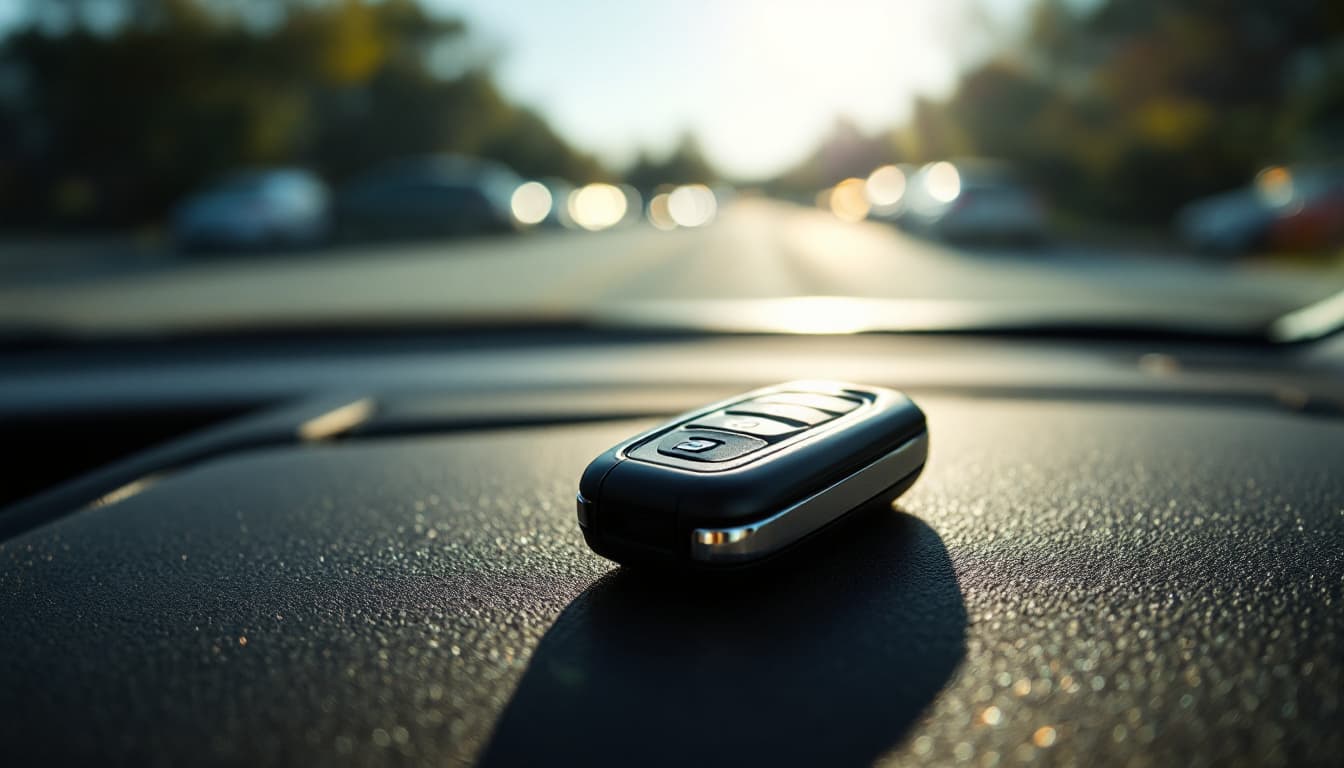
A car that starts every morning and refuses after eight hours in a Fort Worth parking lot has a heat-sensitive fault, and the shortlist is short: a weak fob battery, a failing immobilizer antenna, worn ignition switch contacts, or a receiver module that stops behaving when it gets hot. Those four are key and ignition work — a driveway appointment as of September 2026, with fresh keys in the $130 – $450 range depending on key type and cylinder work quoted per vehicle. Three other causes sit outside a locksmith's scope entirely, and the test tree below tells you which side you are on in about five minutes. Call or text 817-674-2304.
The Pattern Is Most of the Diagnosis
Intermittent faults are hard. Intermittent faults with a reliable trigger are easy, and heat is the most reliable trigger there is.
If the vehicle starts every cool morning, fails in the afternoon, and then starts again once it has sat in shade for half an hour, you are not looking at a random fault. You are looking at a component whose behaviour changes with temperature — a marginal battery voltage, a solder joint that opens as it expands, a contact set that has worn thin enough that thermal expansion is the difference between conducting and not.
Write down three things before you call anyone:
- Does the engine crank? Turning over but not firing is a very different list from silence.
- What does the security or immobilizer light do? Steady, flashing or off, and does that differ between the morning and the afternoon?
- Does the spare key or spare fob behave the same way?
Those three answers narrow the field faster than any tool.
Why This Happens Here More Than Elsewhere
Fort Worth summers do the work. The National Weather Service's Dallas–Fort Worth temperature records show August 2023 as the hottest month in the local record at a 92.9°F monthly average — an average, meaning the afternoons ran far above it. A car parked on unshaded asphalt runs hotter still, and a dashboard in that car hotter again.
Heat is also the leading killer of the 12-volt battery that everything else depends on. AAA Oregon/Idaho reports that AAA expects to assist roughly 1.6 million motorists with dead batteries over a summer and to replace around 500,000 batteries at the roadside. Steve Fox, Director of Automotive Services for AAA Oregon/Idaho, puts it plainly: "Heat is the number one cause of battery failure and reduced battery life." Their guidance also notes a typical three-to-five-year service life, and hot-climate states run at the short end of that.
Hold that last point. It is the single most common reason a heat no-start turns out not to be a key problem at all.
Cause 1: The Fob Battery — Cheap, Common, First to Check
A coin cell that is already weak loses margin when it is hot. That is why a fob can work at 8 a.m. and be ignored at 5 p.m. after sitting in a 140-degree cabin.
The tells are consistent: shorter range before it stops entirely, the car detecting the fob only when it is close to the door handle, and — the giveaway — the vehicle starting when you hold the fob directly against the start button. That last one is the vehicle deliberately falling back to a short-range backup coil, which is exactly what it is designed to do when a fob is too weak to be heard normally.
A coin cell is a few dollars. If your fob has been living on the dashboard, replace it before you spend money on anything else. Related reading: key fob works sometimes covers the intermittent pattern in detail, key fob replacement cost in Fort Worth covers what a replacement costs if the fob itself has failed, and mobile key fob replacement is the service page if you already know that is what you need.
Cause 2: The Immobilizer Antenna
Every chipped key is read by a coil — an antenna ring around the ignition lock on bladed vehicles, or an interior antenna on push-to-start ones. The coil energises the chip and reads it back, and it does that in a fraction of a second every time you start the car.
Antenna rings fail from heat and vibration. When one is marginal, the read succeeds cold and fails hot, and the symptom is a car that cranks normally and dies immediately, or refuses to crank with the security light flashing. It looks exactly like a bad key and it is not.
The clue that separates them: if both of your keys fail the same way in the afternoon, the key is not the variable. Two independently manufactured chips do not develop the same fault on the same day.
This is diagnosable on site. See no key detected for the push-to-start version and module programming for what happens when the fault is upstream of the key entirely. Platform-specific examples we see often in Fort Worth include the Kia K5 and Niro immobilizer and smart key module and Honda's immobilizer control unit.
Cause 3: Worn Ignition Switch Contacts
On any vehicle you start with a key you turn, the cylinder is only half the assembly. Behind it sits an electrical switch that routes power to accessories, then the run circuit, then the starter.
Those contacts wear. As they thin, the connection depends on a tiny amount of physical pressure — and thermal expansion in a hot column is enough to change whether that pressure is sufficient. The result is a car that starts every cool morning and gives you nothing at all in the afternoon, sometimes with dash lights that flicker as you turn the key.
The tell is that turning the key produces no consistent behaviour: sometimes accessories, sometimes not, sometimes a click. A dead battery is consistent. A worn switch is moody.
This is ignition work rather than key work — see ignition repair, and the platform guides for Honda CR-V and HR-V ignition switch repair and Hyundai Elantra and Sonata ignition and immobilizer repair if you own one of those. If your key will not even enter the cylinder, that is a different fault — see when the key will not go into the ignition.
Cause 4: The Receiver or Body Module
Less common, and worth naming because it is the one people never guess.
The module that receives the fob signal and authorises the start contains solder joints. Repeated heat cycling — cold night, 140-degree cabin, cold night — fatigues them over years. A fatigued joint conducts when cool and opens when hot, and the vehicle simply stops hearing a fob that is working perfectly.
The fingerprint is that everything else is fine: strong battery, both fobs behave identically, engine cranks willingly when it does start, and the fault tracks temperature more tightly than anything a key could explain. That is a module-level diagnosis, not a parts-counter one.
What It Is Usually Not: The Honest List
Three heat-related no-starts have nothing to do with keys, and a locksmith who does not say so is costing you a callout.
The 12-volt battery. Hot weather kills batteries faster than cold, per the AAA figures above. A battery weak enough to fail hot often still cranks slowly rather than not at all — but on modern vehicles low voltage produces bizarre, key-shaped symptoms, including a fob that stops being recognised. Have the battery tested first; most parts stores do it free. This applies to hybrids and EVs too, which carry a conventional 12-volt battery alongside the traction pack — see Nissan Leaf and Ariya key replacement for the EV version of the same trap.
Starter heat soak. A starter motor sitting next to a hot exhaust can draw badly when it is heat-soaked, giving you a click or a slow crank in the afternoon and a clean start the next morning. That is a mechanic's job.
Crank sensor and fuel-side faults. A crankshaft position sensor that fails when hot is a classic afternoon no-start where the engine cranks and never fires. Also a mechanic's job.
If your engine cranks normally and simply will not fire, the odds tilt toward that third group. If it will not crank at all, or the security light is misbehaving, the odds tilt toward the first four.
The Five-Minute Test Tree
Run this in the parking lot before you call anybody:
- Turn the key or press the button. Does the engine crank? No crank plus dead dash → battery. No crank plus live dash → ignition switch, immobilizer or starter. Cranks but will not fire → immobilizer or engine-management side.
- Watch the security light. Flashing or staying on after start-up is an immobilizer complaint. Behaviour that differs morning vs afternoon is the confirmation you want.
- Try the spare fob or spare key. Spare works, daily key does not → the key. Both fail identically → the vehicle.
- Hold the fob against the start button (or in the marked backup location for your model) and press. If it starts, you have a fob-signal problem, not a start-system problem.
- Let it sit in shade for thirty minutes and retry. If it starts, the fault is thermal and every hour you spend chasing it in the morning is wasted.
Write down what happened at each step. It is genuinely the most valuable thing you can hand a technician.
What It Costs in Fort Worth
Key ranges are the published bands on our car key replacement cost page. Typical, not a guaranteed quote.
| Outcome | Typical Fort Worth range | Notes |
|---|---|---|
| Fob coin cell replacement | Nominal | Frequently the entire fix |
| Replacement smart proximity fob | $220 – $450 | Fob, blade cut and programming |
| Replacement remote head key | $160 – $260 | Transponder plus remote |
| Fresh transponder key from code | $130 – $220 | When the key, not the car, is the fault |
| Immobilizer antenna or ignition switch work | Quote required | Column time and parts vary by model |
| Receiver or body module diagnosis | Quoted on the call | Module-level fault, not a key |
| Battery, starter or sensor | Not our work | Mechanic — we will tell you on the phone |
Keeping a Fob Alive Through a Fort Worth Summer
Small habits, real effect:
Keep fobs out of the car. A fob in a pocket lives in air conditioning. A fob in a cup holder or on the dash spends every August afternoon above 130°F.
Replace coin cells on a schedule, not on failure. Once a year, before summer, costs a few dollars and removes the single most common cause on this page.
Park in shade when the choice exists. Obvious, and it also buys the 12-volt battery months of life.
Do not ignore the first afternoon. A heat-sensitive fault gets worse, and it fails on the hottest day rather than the most convenient one. If you are already down to a single working key, this is the moment for a spare rather than after the first stranding — spare car key covers that arithmetic.
Mobile Service Across Fort Worth and Tarrant County
If the vehicle will not start, it does not need to move. We come to it — Wedgwood and the southwest, TCU and the near south side, downtown and the medical district, the Stockyards, Ridgmar, Alliance and the far north — plus Arlington, Keller, North Richland Hills, Hurst, Bedford, Euless and Haltom City. The full list is on our service areas page, and after-hours calls run through 24 hour locksmith.
Ownership verification applies before any key work: registration or title in your name plus matching photo ID, under the Texas DPS Private Security Program and Chapter 1702 of the Texas Occupations Code.
Frequently Asked Questions
Why does my car start in the morning but not in the afternoon heat?
Because something in the start chain is marginal and temperature is pushing it over the edge. On the key side that is a weak fob battery, a failing immobilizer antenna, worn ignition switch contacts, or a heat-sensitive receiver module. Off the key side it is usually the 12-volt battery, a heat-soaked starter, or a crank sensor.
Can heat kill a key fob?
It shortens the coin cell's life dramatically and can damage the fob's electronics over years, especially if the fob lives on a dashboard. A fob that only works when held against the start button is almost always a battery or antenna problem rather than a dead fob.
The engine cranks but will not start when it is hot. Is that a locksmith problem?
Sometimes. Cranking rules out the battery and starter, which leaves the immobilizer on our side and engine-management faults such as a crank sensor on a mechanic's side. The security light behaviour is the tie-breaker, and we will say so on the phone rather than send a technician for someone else's repair.
Both of my fobs stop working in the afternoon. What does that mean?
That the fobs are probably fine. Two independently built fobs do not develop the same fault on the same day, so the vehicle's receiver, antenna or 12-volt supply becomes the likely cause. That is a diagnostic visit rather than a parts order.
Should I replace the battery first?
If the vehicle is over three years old on its original battery, yes — have it tested before anything else. Hot-climate batteries live at the short end of the three-to-five-year range, and low voltage produces symptoms that look exactly like key faults on modern vehicles.
How much does the key-side repair cost in Fort Worth?
A coin cell is nominal. A replacement smart fob is $220 – $450 and a remote head key $160 – $260 as of September 2026. Immobilizer antenna or ignition switch work is quoted per vehicle because column disassembly time and parts availability vary by model.
Will parking in shade actually fix it?
It will postpone it. Shade lowers cabin and column temperatures enough that a marginal component keeps working, which is useful information — if shade changes the outcome, the fault is confirmed thermal — but the component is still failing and it will eventually fail in shade too.
Can you come out the same day?
Yes. Same-day service is normal across Fort Worth and Tarrant County and after-hours dispatch is available around the clock. If you are stranded in a parking lot rather than at home, say so when you call and it is treated as an emergency.
Tell Us What Happened at 5 p.m., Not Just That It Failed
The pattern is the diagnosis, and you already have it.
Call or text 817-674-2304 with your year, make and model, whether the engine cranks, what the security light does, and whether the spare behaves the same way. If the honest answer is that you need a mechanic and not a locksmith, we will tell you that on the phone — before anyone drives out.
Article written by the Fortworthlocksmithexperts Automotive Locksmith Team. For mobile automotive locksmith service throughout Fort Worth and Tarrant County, contact us at 817-674-2304.
Locked out or need a key now?
Mobile auto locksmith service across Fort Worth and the surrounding metroplex. We come to you — 24/7.
Call 817-674-2304