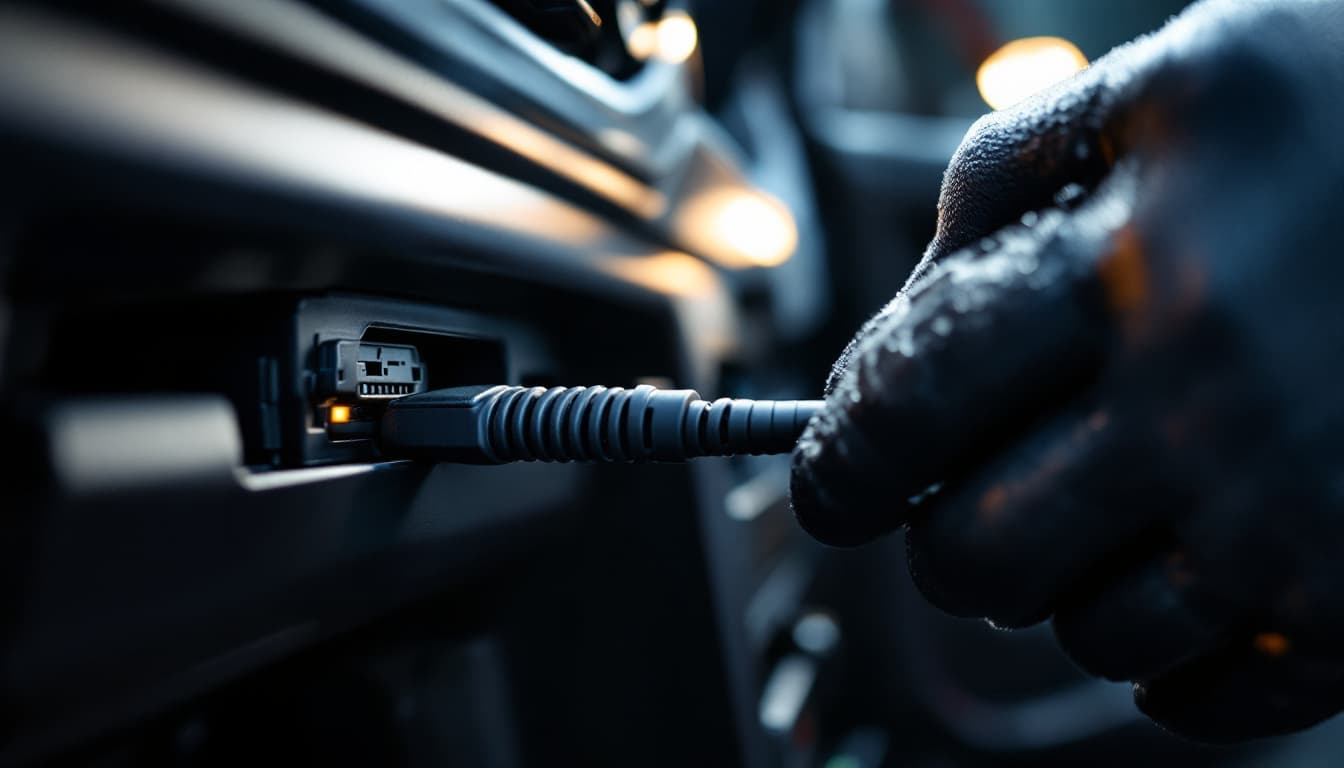
There's a category of Hyundai job that isn't really key cutting at all. A smart-key control module gets replaced after a water intrusion. An immobilizer unit is swapped from a donor vehicle. A theft attempt damages the steering column and the replacement parts arrive unmarried to the car. In each case the vehicle has good hardware that doesn't recognize itself yet, and what it needs is programming, not a locksmith with a key machine.
Hyundai gates that programming behind a security PIN derived from the vehicle. As of July 2026, a Fort Worth technician handling a Palisade or Santa Fe immobilizer job needs three things: the PIN for that VIN, equipment that can talk to the relevant control module, and — on newer model years — authorized access through Hyundai's secure gateway. When any of those is unavailable, the honest answer is that the job belongs at a dealer, and you should get that answer before a truck rolls, not after. Call or text 817-674-2304 with the year and VIN.
Quick Answer: What Is Hyundai Immobilizer Programming?
Hyundai's anti-theft system stores a cryptographic relationship between three things: the transponder or smart key, the immobilizer or smart-key control module, and the engine control unit. A key that isn't registered won't start the vehicle. A module that isn't married to the ECU won't either, even with a perfectly good key.
Immobilizer programming is the process of re-establishing those relationships. It covers:
- Registering new or additional keys to an existing module
- Marrying a replacement smart-key control module to the vehicle
- Teaching a replacement or donor immobilizer unit to the existing ECU
- Clearing and rebuilding the registered key list after a theft attempt or a used purchase
All of it is gated by a security PIN tied to the VIN — which is the point of the design. Without the PIN, the module won't enter programming mode.
What This Work Costs in Fort Worth
Key-side work follows the typical Fort Worth ranges on our car key replacement cost page. Module-side work is quoted per vehicle, because the variable is which module and which model year.
| Hyundai job | Typical Fort Worth range | Notes |
|---|---|---|
| Standard transponder chip key | $130 – $220 | Bladed-key Santa Fe trims; cut and registered to the immobilizer |
| Remote head key | $160 – $260 | Blade with integrated remote buttons |
| Smart proximity fob (push-to-start) | $220 – $450 | Palisade and push-button Santa Fe trims |
| All-keys-lost surcharge | +$50 – $200 | Added when no working key exists |
| Immobilizer / smart-key module programming | Quote required | Depends on module, model year, and gateway access |
These are typical Fort Worth ranges, not a guaranteed quote. Module programming genuinely can't be priced from a phone description alone — the year and the specific module determine both feasibility and time.
The PIN by VIN Requirement
Hyundai's immobilizer will not enter programming mode without a security code specific to that vehicle. This is a deliberate anti-theft measure and it works: it's the reason someone can't walk up to a Palisade in a Hulen parking lot with a laptop and drive off.
Practically, it means two things for you as an owner:
Ownership verification isn't optional. Texas locksmith work operates under the Texas Department of Public Safety Private Security Program, established in Chapter 1702 of the Texas Occupations Code. A technician obtaining a security PIN for your vehicle has to establish that you're entitled to it — current registration or title in your name plus a matching government photo ID. If a company offers to skip that, walk away. The verification protecting your vehicle from a stranger is the same verification that briefly inconveniences you.
PIN availability varies by model year. For most of the Santa Fe's run and the Palisade's early years, the PIN is retrievable through established channels. On the newest model years, access is tighter and increasingly runs through manufacturer-authorized systems.
What's Field-Programmable and What Isn't
This is where a lot of Fort Worth owners get a runaround, so here it is plainly.
Usually field-programmable:
- Adding a key or fob to a Palisade or Santa Fe where a working key already exists
- All-keys-lost key registration on the majority of model years, with a PIN and a security wait period
- Clearing a registered key list and re-teaching only the keys you actually hold
- Replacing a bladed key or a smart fob with the correct part number
Frequently not field-programmable:
- The newest model years where security gateway access is required and only manufacturer-authorized tools can pass it
- Component-level ECU work where the engine controller itself has to be re-paired
- Modules with manufacturer anti-theft protection that requires a dealer-side authorization step
- Any procedure requiring a factory tool with a live manufacturer subscription tied to a franchised dealer
We check your specific year against what's actually achievable in the field before dispatching a technician. That call takes two minutes and saves you a service fee for a truck that shows up and can't do the job. Anybody who won't have that conversation with you on the phone is selling you a trip charge.
The Situations That Bring Palisades and Santa Fes to Us
Theft attempts and column damage. A damaged ignition assembly or a forced column often means new hardware that arrives unregistered. The vehicle needs both the physical repair and the programming to accept it.
Water intrusion. Control modules mounted low in the vehicle don't tolerate flooding. Fort Worth gets flash flooding, and a Santa Fe that sat in high water on a low-lying street can end up with a smart-key module that no longer recognizes anything.
Used or donor modules. A module pulled from another vehicle carries that vehicle's identity. Fitting it isn't the job; teaching it to your ECU is. Some modules can be re-married in the field and some can't, and the model year is what decides.
Used-vehicle purchases with one key. Buying a Palisade with a single fob and no idea how many others exist is common. Clearing the registered key list and re-teaching only your keys revokes every fob you don't hold. Worth doing on principle. For the general version, see our module programming page.
Symptoms That Point at the Module Rather Than the Key
- The engine cranks and immediately dies, with an immobilizer or key-shaped warning lit. Classic immobilizer rejection. Could be the key, could be the module — the diagnosis distinguishes them.
- Every key stopped working at the same time. Two fobs rarely fail on the same morning. Suspect the module, the receiver, or the vehicle's 12-volt battery.
- The car started fine until a module was replaced elsewhere. That's an unmarried module and it's exactly this job.
- Intermittent no-start that comes and goes with temperature or moisture. Points at a module or connector, not a transponder chip.
- A brand-new correctly-cut key won't register at all. Either the PIN path is blocked or the module isn't accepting programming.
By contrast, if the vehicle cranks and runs normally but a remote button doesn't work, that's remote-side and it lives on our key fob programming page — not an immobilizer problem at all.
What the Appointment Looks Like
Pre-dispatch phone check (2–5 minutes). Year, model, VIN, symptom, and what parts have already been replaced. This is where we determine whether the job is field-viable at all.
Ownership verification (5 minutes). Registration or title plus matching ID, on-site.
Diagnosis (15–25 minutes). Reading fault codes from the relevant modules, confirming whether the key, the module, or the ECU relationship is the failure point, and verifying the vehicle's 12-volt battery is healthy enough to support a programming session. A weak battery mid-programming is a real way to make a bad situation worse.
Programming (30–90 minutes). PIN retrieval, module access, registration or marriage, key registration as needed. Security wait periods add time on all-keys-lost work and the vehicle enforces them regardless of who's holding the tool.
Verification (10 minutes). Every key tested for start, remote functions confirmed, fault codes cleared and re-read to confirm they don't return.
Budget an hour and a half or more for real module work. It is not a fifteen-minute job and anyone quoting it as one hasn't done many.
Keep the Spare Key Conversation Separate
If your Palisade or Santa Fe is currently running fine on one key, you don't need any of the above. You need a spare — a routine registration against a healthy module, in the $220 – $450 range for a smart fob, done in your driveway in under an hour.
The module work on this page is what happens when that spare didn't exist and something went wrong. The economics of getting ahead of it are laid out in our spare car key guide, and the all-keys-lost path is in our lost car key with no spare guide.
Serving Fort Worth and Tarrant County
We handle Hyundai immobilizer and key work throughout Fort Worth — Alliance and the far north, downtown, the medical district, TCU and the near south, Ridgmar and the west side, Wedgwood and the southwest — plus Arlington, Keller, North Richland Hills, Haltom City, Hurst, Bedford, and Euless. Full coverage on our service areas page.
Module programming needs a stable environment — a driveway, a garage, or a parking space where the vehicle can sit with the ignition on for an extended session. A shoulder on I-30 is not that. If the vehicle is somewhere unsafe, the first job is relocating it, and that's a tow rather than a locksmith call.
Why Access Keeps Getting Tighter
The trend toward gateway-protected programming isn't manufacturers being difficult. It's a direct response to a specific problem: aftermarket programming tools being used to steal cars.
The controlled channel for security-sensitive vehicle data is the National Automotive Service Task Force's Vehicle Security Professional registry, which operates the Secure Data Release Model. It's the mechanism by which an independent technician — rather than only a franchised dealer — can legitimately obtain the PIN your Palisade's immobilizer demands.
Per NASTF's Secure Data Release Model, access to key programming, immobilizer services, and other advanced diagnostic functions is granted only after business validation, criminal background checks, confirmation of professional standing, and documented proof of the vehicle owner's authority — with transactions monitored for unusual activity. — NASTF VSP Registry (SDRM)
The scale and the friction are both deliberate. The registry was founded in 2008 and now includes more than 9,000 NASTF participants. Applicants must supply business registration documents, a driver's license, and a locksmith license, and consent to a background check; typical approval takes three to ten days, sometimes as long as two weeks. NASTF has continued extending this model toward validating the aftermarket scan tools themselves, precisely because unvalidated programming hardware became a theft vector.
That is the real reason your model year matters. As manufacturers move key programming behind secure gateways, the question stops being "does the technician have a good tool" and becomes "is the technician's access validated for this vehicle." A shop that answers that question honestly before dispatch is doing you a favor; one that promises anything is guessing with your money.
The state layer and the outcome
Texas licenses locksmith companies and individual technicians through the Texas DPS Private Security Program, authorized under Chapter 1702 of the Texas Occupations Code. Professional certification runs through ALOA, the Associated Locksmiths of America.
The combined effect is measurable. The National Insurance Crime Bureau reports U.S. vehicle thefts fell 23.2% from 2024 to 2025 — from 850,708 to 659,880, the lowest levels in decades — measured against reports entered into the FBI-managed National Crime Information Center database.
The cost to legitimate owners is real but modest: an ownership check at the start of every appointment, and an honest conversation about whether your specific model year can be programmed in the field. Both are worth it.
On the ownership side, one deadline catches recent buyers out. The Texas Department of Motor Vehicles requires a vehicle to be titled in the buyer's name within 30 days of the date of sale, with delinquent-transfer penalties after that. A signed title and the prior registration will get an appointment done, but the transfer still has to be finished.
The whole architecture traces back to a federal requirement. FMVSS 114, the theft-protection and rollaway-prevention standard NHTSA administers, requires a starting system that prevents normal activation of the engine whenever the key is removed (NHTSA, FMVSS No. 114). The immobilizer in your Palisade is how Hyundai satisfies that — and the PIN gate is how the industry keeps the satisfying part from being trivially bypassed.
Frequently Asked Questions
What is a Hyundai PIN by VIN and why is it needed?
It's a vehicle-specific security code required to put the immobilizer into programming mode. Without it, no key or module can be registered. The requirement is deliberate anti-theft design — it's the reason someone can't program themselves a key to your Palisade in a parking lot.
Can a locksmith program a Hyundai smart-key module, or does it need a dealer?
It depends on model year. Key registration and many module procedures are field-programmable on most Palisade and Santa Fe years. The newest years where secure gateway access is required, and some component-level ECU work, genuinely need a dealer. We check your specific year before dispatching, not after.
How much does Hyundai immobilizer programming cost in Fort Worth?
Key-side work follows standard ranges — $130 – $220 for a transponder key, $220 – $450 for a smart proximity fob. Module programming is quoted per vehicle because the module type, the model year, and gateway access requirements all change what's involved.
My Hyundai cranks but dies immediately. Is that the immobilizer?
Very likely. Cranking and dying with an immobilizer or key warning lit is the signature of the anti-theft system cutting fuel or spark because it doesn't recognize the key. Whether the fault is the key, the module, or the relationship between them is what the diagnosis determines.
All my Hyundai keys stopped working at once. What does that mean?
Almost certainly not both keys failing simultaneously. Suspect the smart-key control module, the receiver, or the vehicle's 12-volt battery. Diagnosis starts with the battery, because a weak one produces symptoms that mimic a dead module.
Can you program a used immobilizer module from another Hyundai?
Sometimes. A donor module carries the source vehicle's identity and has to be re-married to your ECU. Whether that's achievable in the field depends heavily on the model year and the module's anti-theft protection. Tell us the part number and year and we'll tell you honestly.
I bought a used Palisade with one key. Can old keys still start it?
Yes, unless the registered key list is cleared and rebuilt. Any fob a previous owner kept remains valid until then. Re-teaching the list with only the keys you hold revokes the rest, and it's worth doing on any used purchase.
Does the 12-volt battery matter for programming?
Significantly. A programming session holds modules awake for an extended period, and a weak battery can cause the session to fail partway through — which is a considerably worse position than where you started. A healthy battery is checked before programming begins.
Get an Honest Feasibility Answer First
The most useful thing a Fort Worth locksmith can do on a Hyundai immobilizer job is tell you the truth about your model year before anyone drives out. Some of this work is routine. Some of it belongs at a dealer. Nobody benefits from finding that out with a technician standing in your driveway.
Call or text 817-674-2304 with your year, model, VIN, the symptom, and any parts that have already been replaced. We'll tell you what's field-viable, quote what we can quote, and be straight with you about what we can't. For simple key work on a running vehicle, see car key replacement; if the vehicle is stranded, our emergency auto locksmith dispatch covers it.
Article written by the Fortworthlocksmithexperts Automotive Locksmith Team. For mobile automotive locksmith service throughout Fort Worth and Tarrant County, contact us at 817-674-2304.
Locked out or need a key now?
Mobile auto locksmith service across Fort Worth and the surrounding metroplex. We come to you — 24/7.
Call 817-674-2304