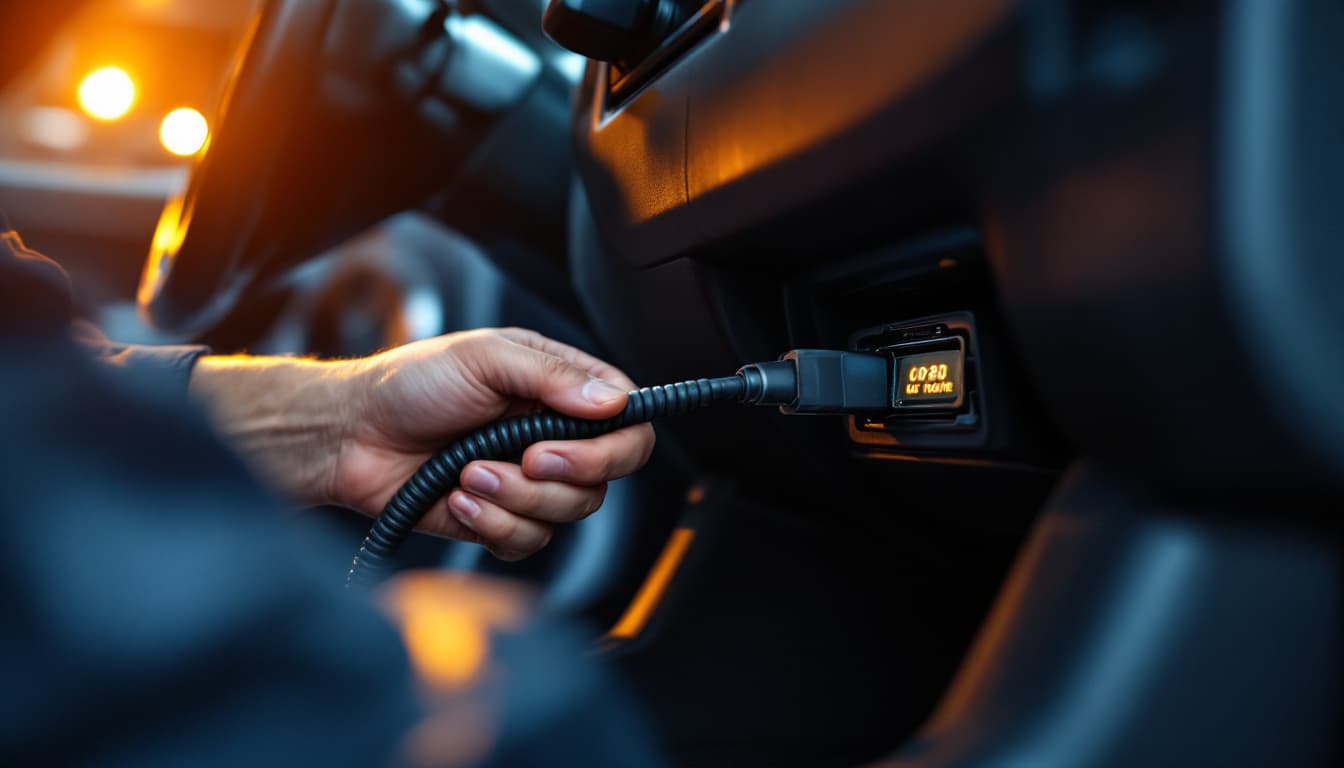
If your Kia K5 or Niro cranks strongly, runs for a second or two and then dies — usually with an immobilizer or key-shaped warning light on the cluster — the fault is almost never a bad starter and often not the key at all. It is the security handshake between the key, the smart key module and the engine controller, and it is diagnosed and reprogrammed on-site in Fort Worth. Bring the VIN; call or text 817-674-2304 and describe exactly what the dash does, because that behavior narrows the cause before anyone is dispatched.
This is the one automotive symptom that gets misdiagnosed more than any other. Drivers replace batteries, starters and fuel pumps chasing a problem that lives entirely in the anti-theft system.
Read the Symptom Correctly First
What the car does in the first three seconds tells you most of what you need to know.
| What happens when you try to start | What it usually points to |
|---|---|
| No crank, no dash lights, nothing | 12-volt battery or main power — not a key problem |
| Cranks strong, fires, dies in 1–2 seconds, immobilizer light on | Immobilizer rejected the credential — security system |
| "Key not detected" on a push-button Niro or K5, no crank | Smart key module, antenna, or a dead fob |
| Key turns but nothing happens, no dash change | Ignition switch or lock cylinder — see below |
| Starts fine with one key, never with the other | That specific key lost its registration |
| Intermittent — works cold, fails hot, or vice versa | Marginal module, connector, or antenna coil |
That second row — start-and-die — is the classic immobilizer signature. The engine controller allowed a brief run, asked the security system for authorization, did not receive a valid answer, and shut fuel off. That is the system doing its job, not failing.
The fourth row is a mechanical problem, not an electronic one; our ignition repair page covers that path.
What's Actually Talking to What
On a modern Kia, starting the car is a conversation between several parts, and any link can break it.
The key or fob holds an encrypted credential — a transponder chip in a bladed key, or a proximity credential in a smart fob.
The antenna — a coil around the ignition lock on bladed-key cars, or interior antennas distributed through the cabin on push-button cars — is what physically reads the key.
The immobilizer control unit or smart key module is the arbiter. It reads the credential, checks it against the list of keys registered to this specific vehicle, and decides.
The engine control unit will not sustain fuel and spark until that module tells it the key is legitimate. On many vehicles the engine controller and the security module are cryptographically paired to each other, which is why swapping a used module from another car generally does not work — the two halves have to be introduced to each other by a programming session.
When any single element is replaced — module, engine controller, or key — the set has to be re-synchronized. That synchronization is what "module programming" means in practice. It is not a firmware upgrade; it is re-establishing trust between components.
The general version of this work across other makes is on our module programming page.
Where the K5 and Niro Differ
Kia K5 (2021–2026) replaced the Optima and arrived firmly in the push-button, smart-key era across most trims, with a smart key module handling proximity detection through interior antennas. Symptoms here tend to be "key not detected" rather than start-and-die.
Kia Niro (2017–2026) is the more interesting diagnostic case because it is a hybrid or EV. Two batteries live in the car, and only one of them is relevant to your key problem: the 12-volt battery runs the body electronics, the smart key module, and the diagnostic port. A Niro with a healthy traction battery and a tired 12-volt produces exactly the sort of intermittent, nonsensical no-start that sends people down expensive wrong paths.
Before assuming module failure on a Niro, get the 12-volt tested. A battery that reads acceptable at rest can still sag below what the security modules need during cranking, and the resulting fault looks electronic.
What Programming Actually Involves
Diagnosis first — 15 to 25 minutes. The technician connects to the diagnostic port, reads stored fault codes across the security and engine modules, checks live data while attempting a start, and confirms whether the key is being read at all. This step exists so nobody replaces a working part.
Retrieving the security credential — variable. Programming a Kia immobilizer requires the vehicle-specific security PIN, which is released through manufacturer channels against proof of ownership and technician credentials. It is not stored in the car in a form anyone can simply read out.
Registering or re-synchronizing — 20 to 60 minutes. Depending on what the diagnosis found: re-registering existing keys, adding new ones, or pairing a replacement module to the engine controller. Some of that window is the vehicle's enforced security wait, which no equipment shortens.
Verification — 10 minutes. Start with every key, confirm proximity entry and remote functions, then clear and re-read codes so nothing is left logged.
Because the diagnosis drives the work, immobilizer jobs are quoted after the fault is identified rather than blind over the phone. What we will quote before dispatch is the diagnostic visit and the key ranges below, so there are no surprises about the starting point.
What Keys Cost If the Diagnosis Points at the Key
From the typical Fort Worth ranges on our car key replacement cost page.
| Key type | Typical Fort Worth range |
|---|---|
| Standard transponder chip key | $130 – $220 |
| Remote head key | $160 – $260 |
| Flip key | $170 – $290 |
| Smart proximity fob (push-to-start K5, Niro) | $220 – $450 |
| All-keys-lost surcharge | +$50 – $200 |
Typical ranges, not a guaranteed quote. Module work is priced separately after diagnosis, because "the module is bad" and "one key lost its registration" are wildly different jobs that produce identical symptoms in the driver's seat.
The Newest Model Years and an Honest Limit
Hyundai and Kia have tightened programming access substantially in recent model years, and some procedures on the newest vehicles are restricted to manufacturer-authorized access.
We check your specific year and VIN against what is actually achievable before dispatching a technician. If your car falls on the wrong side of that line, you hear it on the phone rather than after paying for a trip. That honesty costs us jobs occasionally and it is still the right policy — the alternative is charging someone to discover a limitation we already knew about.
What Not to Do While You're Troubleshooting
Don't buy a used module from a salvage yard. On paired systems it will not simply drop in, and you will have spent money before the diagnosis.
Don't order a fob online yet. Until the diagnosis says the key is the problem, a new fob solves nothing — and the wrong part number for your VIN solves nothing either. Our key fob replacement page covers what to look for if it does turn out to be the fob.
Don't keep cranking. Repeated attempts on a start-and-die fault drain the 12-volt, and a low 12-volt then adds fresh false symptoms on top of the original one.
Do note the pattern. Time of day, temperature, whether one key works and the other does not, whether it fails only after the car sits. Intermittent faults are diagnosed by pattern, and yours is the only record of it.
Why the Ownership Check Comes First
Immobilizer programming is the deepest access a technician can have to a vehicle's security system, so verification is not optional.
Texas locksmith work is regulated under the Texas Department of Public Safety Private Security Program, authorized under Chapter 1702 of the Texas Occupations Code. Separately, the manufacturer data required for this work — security PINs, immobilizer access, key codes — is released through the National Automotive Service Task Force's Vehicle Security Professional registry under its Secure Data Release Model.
Per NASTF's Secure Data Release Model, access to key programming and immobilizer functions is granted only after business validation, criminal background checks, confirmation of professional standing, and documented proof of the vehicle owner's authority — with transactions monitored for unusual activity. — NASTF VSP Registry (SDRM)
The registry was founded in 2008 and now includes more than 9,000 NASTF participants, with credentialing that requires business registration documents, a driver's license, a locksmith license, and a background check — typically three to ten days to approve. Trade certification runs through ALOA, the Associated Locksmiths of America.
The system this protects
The National Insurance Crime Bureau reports U.S. vehicle thefts fell 23.2% from 2024 to 2025 — from 850,708 to 659,880 — based on reports entered into the FBI-managed National Crime Information Center database. Immobilizer systems and controlled key-data access are a substantial part of that decline. Federally, FMVSS 114 requires that a vehicle's starting system prevent engine activation whenever the key is removed (NHTSA, FMVSS No. 114) — the standard your immobilizer exists to satisfy.
On pricing, the Federal Trade Commission's advertising guidance treats advertised prices that are not genuinely available as deceptive. For diagnostic work that means quoting the diagnosis honestly and the repair only once the fault is known.
Serving Fort Worth and Tarrant County
Immobilizer calls come from across the metro — driveways in Wedgwood and Ridglea, apartment lots near TCU, office garages downtown and in the medical district, the Alliance corridor — plus Arlington, Keller, North Richland Hills, Hurst, Bedford, Euless, and Haltom City. Full list on our service areas page.
If the car is drivable and you simply want a second key made before something goes wrong, that is a different and much cheaper visit — see spare car key. If you are stranded right now, after-hours dispatch runs through our 24-hour locksmith line.
Frequently Asked Questions
My Kia K5 cranks but dies after a second. Is that the immobilizer?
Very likely, especially with an immobilizer or key-shaped light on the cluster. The engine controller allowed a brief run, asked the security system to authorize the key, got no valid answer, and cut fuel. That is the anti-theft system working, not a mechanical failure.
Can this be fixed without towing the car to a dealership?
In most cases yes. Diagnosis, credential retrieval, and programming happen at the vehicle. The exception is the newest model years where certain procedures are restricted to manufacturer-authorized access — we check your VIN before dispatch so you find out on the phone, not in your driveway.
Is it the key or the module?
That is exactly what the diagnostic step determines, and it cannot be answered reliably over the phone. If one key works and another does not, the failed key lost its registration. If no key works and the vehicle reports it cannot read a key at all, attention moves to the antenna and the smart key module.
Why does my hybrid Niro act like it has an electrical fault?
Usually the 12-volt battery, not the traction battery. The 12-volt runs the body electronics, the smart key module, and the diagnostic port, and a weak one produces intermittent no-starts that look electronic. Have it tested before replacing modules.
Can I install a used module from a salvage yard?
Generally not as a drop-in. On paired systems the security module and engine controller are cryptographically matched, so a used unit still requires a programming session to be introduced to your vehicle — and may not be usable at all.
How much does immobilizer programming cost in Fort Worth?
It is quoted after diagnosis, because identical symptoms come from very different jobs. What we quote up front is the diagnostic visit plus the key ranges — $130 – $220 for a transponder key up to $220 – $450 for a smart proximity fob, with a $50 – $200 surcharge if all keys are lost.
Will programming erase my existing keys?
It depends on the procedure the vehicle requires. Some register a new key alongside existing ones; others rebuild the registered key list, which invalidates keys not present. Bring every key you own to the appointment so all of them end up registered.
What do I need to have ready?
Current Texas registration or the title in your name, a matching government photo ID, every key you have — including ones you think are dead — and the VIN.
Get It Diagnosed Before You Replace Parts
The expensive version of this problem is the one where three parts get replaced before anyone reads a fault code. The cheap version starts with a diagnostic connection and a look at what the security module is actually reporting.
Call or text 817-674-2304 with your year, model, VIN, and a description of exactly what the dash does when you try to start it. Mobile service across Fort Worth and Tarrant County.
Article written by the Fortworthlocksmithexperts Automotive Locksmith Team. For mobile automotive locksmith service throughout Fort Worth and Tarrant County, contact us at 817-674-2304.
Locked out or need a key now?
Mobile auto locksmith service across Fort Worth and the surrounding metroplex. We come to you — 24/7.
Call 817-674-2304