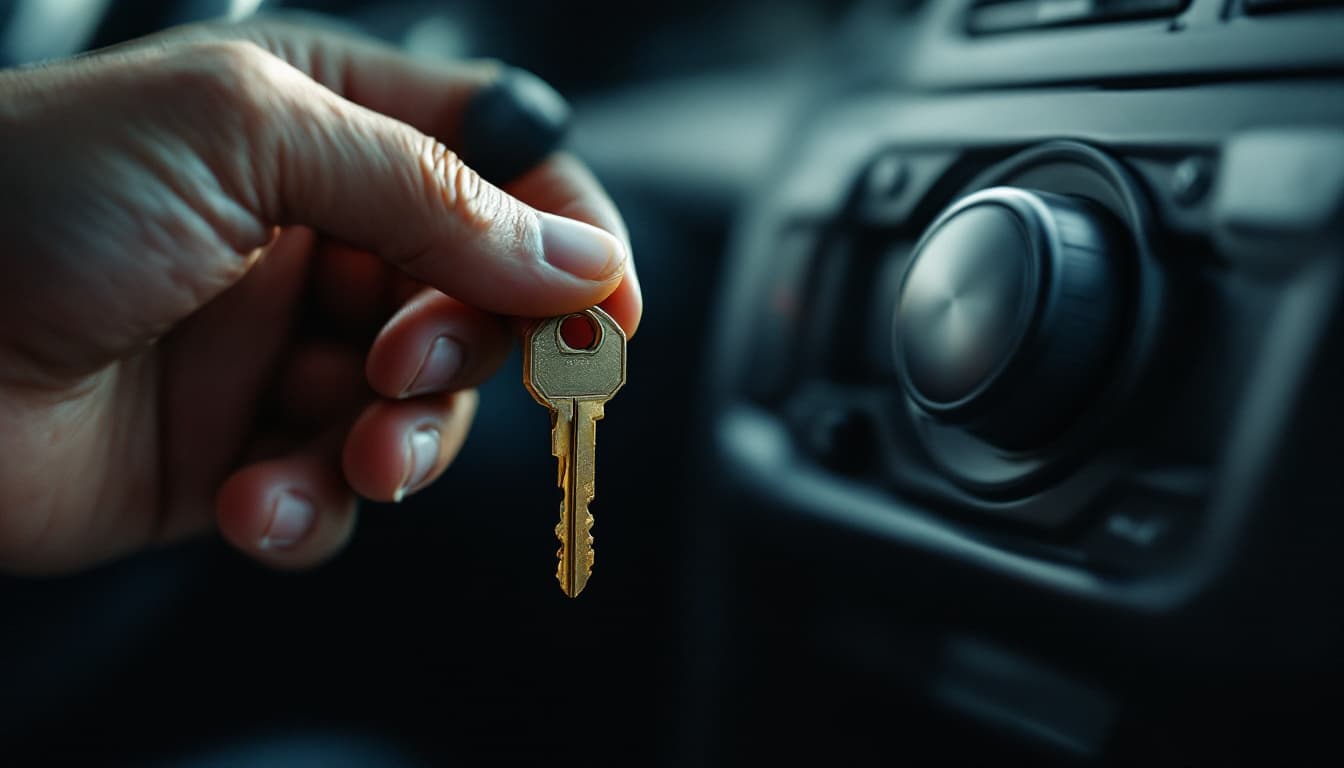
If your key will not physically enter the ignition, the fault is mechanical and it is one of five things: debris packed into the keyway, a worn or badly cut blade, a bent blade, a broken wafer inside the cylinder, or the wrong key. That is genuinely good news compared with a key that goes in and will not turn, because a blocked keyway rules out the immobilizer, the security system and the battery entirely. As of September 2026 the common fix — a fresh key cut to the vehicle's factory code — sits in the $50 – $220 range depending on whether your key carries a chip; cylinder work is quoted per vehicle. Call or text 817-674-2304.
"Will Not Go In" Is a Different Fault From "Will Not Turn"
The distinction matters more than any other thing on this page, so start here.
A key that enters fully and will not turn points at the cylinder mechanism, the steering column lock, or the vehicle's shifter interlock. Those are three different repairs.
A key that will not enter at all — or goes in a quarter inch and stops — is a shape problem. Something is physically in the way, or the shape of your key no longer matches the shape the lock expects. Electronics have nothing to do with it. Nothing about the chip, the fob battery or the security light changes whether a piece of metal fits into a slot.
That is why the diagnosis below is short. There are not many ways for a slot to refuse a key.
The Five Causes, in the Order We Find Them
1. Debris in the keyway
The most common cause and the least expensive. Ignition keyways sit at knee height in a footwell that collects lint, pocket grit, sand from summer trips out to Benbrook Lake, and — in a surprising number of Fort Worth cars — the powder left behind by a broken key ring charm.
Material packs into the bottom of the keyway and the key runs out of depth before the wafers line up. It feels exactly like a broken lock and it usually is not one.
2. A worn blade, or a copy of a copy
Keys wear. Every insertion drags brass across steel wafers, and after fifteen years the peaks of the cut are visibly rounded. A worn key first becomes sticky, then needs jiggling, then eventually will not seat.
The version of this we see most often is the copy-of-a-copy problem. A key duplicated from a worn key inherits the wear, and the next duplicate compounds it. Three generations in, the key is no longer a match for the factory code — it is a match for its own ancestor's damage. That is why the fix is often to cut a fresh key to the vehicle's code rather than to duplicate the key in your hand.
3. A bent or twisted blade
Sitting on a key bends it. So does using it as a screwdriver, a box cutter or a paint scraper — all three of which we have been shown by the customer while explaining the problem.
A blade bent even a degree or two out of plane binds against the keyway walls. It sometimes still works in the door lock, which is a useful clue: the door cylinder is shallower and more forgiving than the ignition.
4. A broken wafer, spring or tip inside the cylinder
Wafers are small spring-loaded plates. They break, and when one breaks it can sit across the keyway and stop a key dead.
The other version of this is a piece of a previous key. If a key snapped off in this ignition at any point — even years ago, even if someone "got it all out" — the tip may still be in there. Our broken key extraction guide covers that case specifically.
5. The wrong key
It happens more often than anyone admits, and it is worth ruling out in five seconds rather than paying to have it ruled out. Fleet vehicles, families with two of the same model, apartment lots at night, and rental returns are the usual settings.
Five Checks Before You Call Anyone
1. Try the spare. This single test splits the diagnosis in half. If the spare goes in cleanly, your daily key is worn, bent or damaged and the cylinder is fine — a new key from code solves it. If neither key enters, the problem is inside the lock.
2. Try the same key in the driver's door. If it enters the door but not the ignition, the key is marginal rather than wrong, and the shallower door lock is tolerating what the ignition will not.
3. Look at the blade in good light. Compare it to the spare if you have one. Rounded peaks, a shiny worn edge, a visible twist, or a bright scratch line down one face all point at the key.
4. Blow the keyway out — with air, not liquid. A short burst of compressed air, keyway pointed down so debris falls out rather than in.
5. Check the obvious. Right car, right key, and on a push-to-start vehicle, the emergency blade is not always meant to enter the column at all.
If none of those change anything, stop. Forcing a key that will not go in is how a $60 problem becomes a cylinder replacement.
Why You Should Not Spray Oil Into the Ignition
The instinct is to lubricate, and the usual can under the sink is the wrong one.
Penetrating oils and general-purpose sprays leave a residue that attracts and holds the exact dust and lint that caused the problem. The lock feels better for a week and then binds worse than before, now with a paste inside it instead of loose debris.
Locksmiths use dry lubricants — graphite or a PTFE-based dry spray — precisely because they do not stay wet. The Associated Locksmiths of America trade body's guidance on lock maintenance reflects the same principle: keep the mechanism dry and clean rather than oiled. If you have already sprayed oil in, say so when you call. It changes what the technician brings, not whether the job can be done.
What a Locksmith Actually Does On Site
The work follows the diagnosis, and the sequence is deliberately cheapest-first:
Inspect and clean the keyway. Fibre-optic scope and a pick, not a drill. If it is debris, this ends the call.
Read the key. A worn key can be measured against factory specification. If the cut has drifted, the answer is a fresh key.
Cut to code, not to the key. The vehicle's key code comes from the VIN through licensed channels, and the resulting key matches what the lock was built for rather than what your key has become. On a chipped vehicle the new key is then programmed to the immobilizer — see transponder keys.
Rebuild or replace the cylinder if the lock is the fault. A broken wafer means the cylinder comes apart. On many vehicles it can be rebuilt and re-keyed to your existing key so you do not end up with two different keys for one car.
Verify on both locks. A finished job means the new key works the ignition and the doors, not just the one you called about.
What It Costs in Fort Worth
Key ranges below are the published bands from our car key replacement cost page. Typical, not a guaranteed quote — and the diagnostic itself is quoted on the call.
| What the diagnosis turns out to be | Typical Fort Worth range | Notes |
|---|---|---|
| Debris cleared from the keyway | Service call only | Frequently the whole job |
| Fresh mechanical key cut to code | $50 – $100 | Pre-immobilizer vehicles |
| Fresh transponder key cut to code | $130 – $220 | Cut plus programming |
| Remote head or flip key from code | $160 – $290 | Cut, remote and programming |
| Smart fob emergency blade re-cut | Quoted on the call | Push-to-start vehicles |
| Wafer rebuild or cylinder replacement | Quote required | Parts availability and column time vary by model |
| Broken key extraction | Quoted on the call | Often combined with a fresh key |
The pattern worth noticing: most calls that start as "the lock is broken" end at one of the first three rows. Cylinder work is real and we do it, but it is not the common outcome — which is exactly why an honest shop diagnoses before it quotes a part.
When the Ignition Is Not the Real Problem
Push-to-start vehicles. If your car has a start button, the blade inside your fob is an emergency door key. Some vehicles have no key-operated column at all, so a blade that will not enter the column is not a fault. If the button does nothing, the issue is no key detected, not a lock.
Attempted theft damage. A punched or drilled cylinder will refuse a key and usually shows scoring or a loose, rotating lock face. That is a police-report situation before it is a locksmith one — the National Insurance Crime Bureau tracks these patterns nationally, and your insurer will want the report number.
A column that turns but nothing happens. That is the opposite failure — see ignition repair and, if the key enters and binds rather than refusing entry, our platform-specific guides such as Honda CR-V and HR-V ignition switch repair and Acura TL and RL ignition lock cylinder repair.
Hyundai and Kia steering-lock variants. Several of these platforms fail in a way that mimics a lock problem; Hyundai Kona and Venue ignition and steering lock repair covers what that looks like.
Which Fort Worth Vehicles This Happens To Most
Two groups account for most of these calls.
Older high-mileage vehicles with one original key. Fifteen to twenty-five years of daily insertion wears both the key and the wafers, and because the key and the lock wear together, the failure is gradual and easy to ignore until the morning it is not. These are the cars where a fresh key cut from code fixes something the owner assumed was terminal.
Vehicles whose key has been duplicated repeatedly. Family cars, second cars, work vehicles shared between drivers — anything that has had three or four keys made at a hardware counter over the years. Each duplicate copies the previous key's wear, and the drift compounds until the newest copy no longer resembles the factory cut at all.
There is a third, smaller group: vehicles that have recently been broken into or had an attempted theft. Damage to the door cylinder is obvious; damage to the ignition is not always, and a key that suddenly stops entering after a break-in is not a coincidence.
Preventing the Next One
Three habits, all cheap:
Cut the spare from code, not from the daily key. A duplicate of a worn key is a worn key. Cutting from the vehicle's code resets the clock, and it means your spare is genuinely better than your original.
Take the ignition key off the heavy ring. Weight hanging off a key in a column wears the cylinder and bends blades. A separate ring for the ignition key is the single most effective thing on this list.
Act on stickiness. A key that needs jiggling is a key that will eventually not go in. That is a scheduled $60 appointment now, or an unscheduled one in a parking lot later. If you are already down to one key, our spare car key guide covers the same arithmetic from the other side.
Mobile Service Across Fort Worth and Tarrant County
This is driveway work — the vehicle does not move. We cover Fort Worth from Wedgwood and the southwest to the Stockyards, downtown, the medical district, Ridgmar and Alliance, plus Arlington, Keller, North Richland Hills, Hurst, Bedford, Euless and Haltom City. The full list is on our service areas page, and a general overview of what a car locksmith in Fort Worth handles is a good orientation if this is your first call.
Proof of ownership comes first on any ignition job — registration or title in your name plus matching photo ID. Texas locksmith work operates under the Texas DPS Private Security Program, established in Chapter 1702 of the Texas Occupations Code.
Frequently Asked Questions
Why will my key not go into the ignition at all?
Five causes cover nearly every case: debris packed in the keyway, a worn or badly duplicated blade, a bent blade, a broken wafer or key fragment inside the cylinder, or the wrong key. Because the fault is mechanical, the immobilizer and the vehicle's battery are ruled out immediately.
My spare goes in but my regular key does not. What does that mean?
Your cylinder is fine and your daily key is worn, bent or was cut from an already-worn key. The fix is a fresh key cut to the vehicle's factory code rather than duplicated from the key in your hand.
Can I spray WD-40 or oil into the ignition?
Do not. Oil-based sprays hold the dust and lint that caused the blockage and turn loose debris into a paste. Locksmiths use dry graphite or PTFE lubricants for exactly that reason. Tell us if oil has already been used; it changes what the technician brings.
How much does it cost to fix in Fort Worth?
If the answer is debris, the service call is the job. A fresh key from code runs $50 – $100 on a pre-immobilizer vehicle and $130 – $220 for a standard transponder key. A wafer rebuild or cylinder replacement is quoted per vehicle because column disassembly time and parts availability vary by model year.
Should I force it or tap the key in?
No. Forcing a marginal key is the most reliable way to break a wafer or snap the blade off inside the cylinder, which turns a key-cutting job into a cylinder job. Stop at resistance.
The key goes in halfway and stops. Is that different?
It is the same family. Partial entry usually means either debris at a specific depth or a single broken wafer sitting across the keyway. Both are diagnosed the same way, and both are visible with a scope in under a minute.
My car has push-button start and the fob blade will not enter the column. Is that a fault?
Usually not. On most push-to-start vehicles there is no key-operated column at all — the blade inside the fob is an emergency door key. If the start button is unresponsive, that is a detection problem rather than a lock problem.
Can you come out at night for this?
Yes. Same-day service is normal across Fort Worth and Tarrant County and after-hours dispatch is available around the clock. If you are stranded rather than at home, treat it as an emergency auto locksmith call.
Get It Diagnosed Before Anything Gets Replaced
A key that will not enter is one of the few automotive faults where the cheap answer is also the most common one.
Call or text 817-674-2304 with your year, make and model, and whether the spare works. Those two facts usually tell us which of the five causes you are looking at before a technician leaves — and which end of the price table you are standing at.
Article written by the Fortworthlocksmithexperts Automotive Locksmith Team. For mobile automotive locksmith service throughout Fort Worth and Tarrant County, contact us at 817-674-2304.
Locked out or need a key now?
Mobile auto locksmith service across Fort Worth and the surrounding metroplex. We come to you — 24/7.
Call 817-674-2304