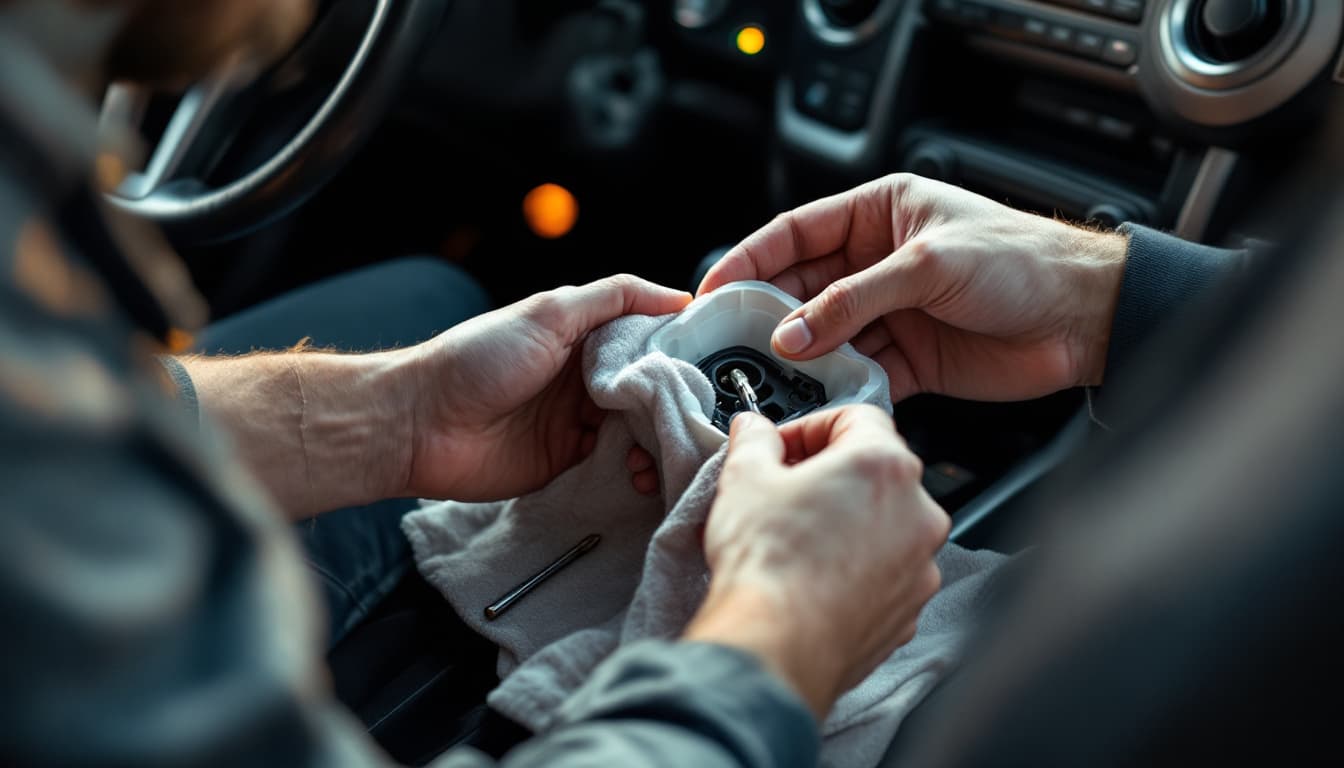
The call usually comes from a parking lot. The Honda CR-V started fine this morning, ran errands all day, and now the key slides into the ignition and simply refuses to rotate. Or it turns halfway and stops. Or it turns, the dash lights come on, and nothing else happens.
Here's the part that saves Fort Worth drivers money: a key that won't turn is rarely a dead ignition switch. As of July 2026, roughly three out of four "my Honda key won't turn" calls we take get resolved without replacing the lock cylinder at all. The fix is a bound steering lock, a worn key that's lost its cut depth, or a shifter interlock that hasn't fully seated in Park. Diagnosis first, parts second. Call or text 817-674-2304 and describe exactly what the key does — that description alone usually narrows it to one of four causes.
Quick Answer: Why Won't My Honda CR-V Key Turn?
Four causes cover almost every case on a CR-V or HR-V:
- The steering wheel is locked against the column. Front wheels turned against a curb or parked on a Fort Worth street with a crown puts load on the steering lock pin. The pin binds, the cylinder can't rotate. Free fix, thirty seconds.
- The key is worn, not the lock. A fifteen-year-old original key that's been the only key since 2011 has lost cut depth. It no longer lifts the wafers to the shear line. The lock is fine; the key isn't.
- The shifter isn't fully in Park. Automatic CR-Vs won't release the ignition unless the transmission range switch reads Park. A shifter resting a millimeter short feels like Park and isn't.
- The lock cylinder wafers are genuinely worn or a wafer has broken. This is the real ignition repair — and it's the least common of the four.
A technician works that list in order because each step costs less than the one after it.
What Ignition Work Costs in Fort Worth
Ignition repair is priced by what the vehicle actually needs, and a large share of calls end at the cheapest line. These reflect typical Fort Worth ranges for the related key work; the diagnostic itself is quoted on the call.
| What the CR-V or HR-V needs | Typical Fort Worth range | When this is the answer |
|---|---|---|
| Diagnosis only (steering lock, shifter, key wear) | Service call rate | Key turns after freeing the wheel or seating the shifter |
| Freshly cut key from code / VIN, chip programmed | $130 – $220 | Worn key, healthy lock — the most common real fix |
| Remote head key replacement | $160 – $260 | Worn key on a CR-V with lock/unlock buttons in the head |
| Lock cylinder rebuild or replacement + key | Quote required | Broken or worn wafers, key spins freely, or the cylinder is seized |
| Smart proximity fob (push-to-start HR-V/CR-V) | $220 – $450 | Push-button models with no mechanical ignition at all |
These are typical Fort Worth ranges, not a guaranteed quote. A cylinder replacement is quoted per vehicle because parts availability and column disassembly time vary by model year. Broader pricing context lives on our car key replacement cost page.
The Steering Lock: Try This Before You Call Anyone
Honda's ignition lock and steering lock share a mechanism. When the wheel is under load, the steering lock pin presses hard against its slot and the ignition cylinder physically cannot rotate.
With your foot off the accelerator and the key in the ignition:
- Grip the steering wheel and apply firm, steady pressure left, then right. You're looking for a small amount of give.
- While holding pressure in the direction that gives, turn the key gently.
- If it doesn't free on the first try, do it in the other direction.
Do not force the key. A bent or snapped key blade inside the cylinder turns a free fix into a broken key extraction plus a new key. Steady pressure, not leverage.
This works on CR-Vs and HR-Vs of every generation with a mechanical ignition. It's the first thing our dispatcher will walk you through on the phone, because if it solves it, nobody needs to drive out.
The Worn Key Problem — Very Common on Older CR-Vs
The CR-V is a vehicle people keep. Second-generation (2002–2006) and third-generation (2007–2011) CR-Vs are still all over Fort Worth, and many are running on the same key they came with.
A brass key blade wears every single time it's inserted. After a decade and a half, the cuts are shallower than spec. The wafers inside the lock no longer rise to the shear line, and the cylinder binds — usually intermittently at first, which is the tell. If your key works "most of the time" or works better if you jiggle it, wiggle it, or lift the key slightly while turning, you have a worn key, not a failing ignition.
The fix is a key cut to the vehicle's original factory code rather than copied from the worn key. Copying a worn key just reproduces the wear. Cutting from code or decoding the lock produces a blade at original spec, and the ignition that "was going bad" turns like new. Then the transponder chip is programmed so the immobilizer accepts it.
This is the single most satisfying diagnosis in automotive locksmithing: a customer braced for a several-hundred-dollar column job pays for a key instead. The end stage of the same wear is a key that will not enter the cylinder at all, which has its own short diagnostic ladder in when the key will not go into the ignition.
When It Really Is the Ignition Cylinder
Some CR-Vs and HR-Vs do need lock cylinder work. The signs are specific:
- The key turns freely with no resistance and nothing happens — a wafer or the cylinder's cam has failed.
- The key won't insert fully, and it isn't debris. A collapsed wafer blocks the keyway.
- The cylinder turns but won't return from the start position, so the starter keeps engaging.
- A fresh factory-code key still binds. If a correctly cut key won't turn, the lock is the problem by elimination.
- The key can be removed while the ignition is in the ON position — a worn cam that's a genuine safety issue.
Cylinder work on these platforms means removing the steering column shrouds, releasing the cylinder retainer, and either rebuilding the cylinder with new wafers keyed to your existing key or fitting a replacement cylinder. If a replacement cylinder is used, it either gets keyed to your current key so you keep one key for everything, or it comes with its own key and you carry two — we'll ask which you prefer, because it changes the labor.
Push-button CR-V and HR-V trims have no mechanical ignition cylinder. Their equivalent failure is in the start-button circuit, the brake switch, or the smart-key receiver — a different diagnosis path that overlaps with no key detected faults.
The Shifter Interlock — The One Everyone Forgets
On automatic CR-Vs and HR-Vs, the ignition will not release to the OFF/LOCK position, and often will not turn from LOCK, unless the transmission range switch confirms Park.
Symptoms that point here rather than at the lock:
- The key won't come out of the ignition even though the engine is off
- The key won't turn from LOCK, but the steering wheel moves freely (so it isn't the steering lock)
- Shifting to Neutral and back to Park, firmly, changes the behavior
Try this: press the brake, move the shifter to Neutral, then back to Park with deliberate pressure until it seats. Then try the key. If that resolves it, the problem is the shift cable adjustment or the range switch — a transmission-side item rather than a lock item, and we'll tell you so instead of selling you an ignition.
What a Mobile Ignition Visit Looks Like
Ignition work is well suited to mobile service because the vehicle usually can't be driven anywhere. A typical Fort Worth visit:
Arrival and interview (5 minutes). What exactly does the key do? When did it start? Does a second key behave differently? That last question is diagnostic gold — if your spare turns fine and your daily key doesn't, the key is worn and the lock is healthy.
Non-invasive checks (5–10 minutes). Steering lock load, shifter seating, keyway inspection under light for debris or a collapsed wafer, key blade measured against factory spec.
Key path (30–45 minutes). If it's the key: cut a blade from the vehicle's factory code, program the transponder to the immobilizer, verify start and all remote functions.
Cylinder path (60–120 minutes). If it's the lock: column shrouds off, cylinder out, rebuild or replace, reassemble, re-key or program as needed, full function test including that the key can only be removed in LOCK.
Everything happens where the vehicle sits — your driveway, a workplace lot, or a shopping center parking space. No tow. If the SUV is stranded somewhere unsafe after dark, that's an emergency car locksmith call and we treat it accordingly.
Don't Let It Get Worse
An intermittent Honda ignition is a warning, not a quirk. Every forced turn wears the wafers further and works the key blade closer to snapping. The customers who spend the most on this repair are the ones who lived with "you just have to jiggle it" for eight months, then snapped the key off inside the cylinder in a Cook Children's parking garage on a Tuesday.
Intermittent binding today is a key job. The same fault ignored until failure is a key job plus an extraction plus a cylinder. There is no version of this that gets cheaper by waiting.
Around Fort Worth and Tarrant County
We handle Honda ignition diagnosis and repair across Fort Worth — the west side, Ridgmar, TCU and Berry Street, the medical district, downtown, Alliance, and the Stockyards — and throughout the surrounding cities including Hurst, Bedford, Euless, Keller, Haltom City, and North Richland Hills. Full coverage is listed on our service areas page.
Texas locksmith companies operate under the Texas Department of Public Safety Private Security Program per Chapter 1702 of the Texas Occupations Code, and ignition work requires the same ownership verification as key cutting: current registration or title in your name plus matching photo ID. Have both ready when the technician arrives.
The Federal Standard Behind Half These Symptoms
A surprising amount of what feels like a broken Honda ignition is actually the vehicle obeying a federal safety standard exactly as designed. Knowing the standard turns three of the four failure patterns on this page from mysteries into expected behavior.
FMVSS 114 — Theft Protection and Rollaway Prevention is administered by the National Highway Traffic Safety Administration. Two of its requirements land directly on your CR-V's keyway:
- Since 1991, vehicles with an automatic transmission that has a Park position must use a key-locking system that prevents removal of the key unless the transmission is locked in Park — or locks the transmission in Park as a direct result of removing the key (NHTSA / Federal Register, FMVSS No. 114).
- Section 5.3 of the same standard requires a brake transmission shift interlock, so the shifter can't leave Park unless the service brake is depressed.
Per FMVSS No. 114, each vehicle must have a starting system that, whenever the key is removed, prevents normal activation of the engine and prevents either steering or forward self-mobility of the vehicle — or both. — NHTSA, Federal Motor Vehicle Safety Standard No. 114
Read that second clause again: "prevents either steering… or forward self-mobility." That is the steering lock. It's not a Honda quirk or a worn part — it's a federally mandated anti-theft device, and its pin binding under load is the single most common reason a CR-V key won't turn. The car is doing its job.
The same standard explains the trapped-key symptom: if your key won't come out with the engine off, the vehicle isn't satisfied the transmission is locked in Park, and the standard forbids releasing the key until it is. And it explains why "I can pull the key out with the ignition on" is a genuine safety fault rather than a convenience — a vehicle behaving that way is out of compliance with the requirement the standard exists to enforce.
Why the anti-theft side matters too
The theft-protection half of FMVSS 114 is not ceremonial. The National Insurance Crime Bureau reports U.S. vehicle thefts dropped 23.2% from 2024 to 2025 — 850,708 down to 659,880 — as measured through the FBI-managed National Crime Information Center. Immobilizers and compliant starting systems are part of why.
The trade-off for owners is that legitimate key work is deliberately gated. Manufacturer key and immobilizer data reaches technicians through the NASTF Vehicle Security Professional registry, founded in 2008 and now counting more than 9,000 participants, with credentialing that includes license verification and a criminal background check. On the state side, Texas locksmith companies operate under the Texas DPS Private Security Program per Chapter 1702 of the Texas Occupations Code, and trade certification runs through ALOA. All of which is why a technician asks for your registration before diagnosing your ignition.
Frequently Asked Questions
Why won't my Honda CR-V key turn in the ignition?
Most often the steering wheel is locked against the column under load — apply firm left-right pressure on the wheel while gently turning the key. The next most common cause is a worn key that no longer lifts the lock wafers to the shear line. A genuinely failed ignition cylinder is the least common of the four typical causes.
Can a locksmith fix a Honda ignition without towing the car?
Yes. Ignition diagnosis, key cutting from factory code, transponder programming, and cylinder rebuild or replacement are all mobile jobs performed where the vehicle sits. That's the point of mobile service — a car with a bad ignition usually can't be driven to a shop.
How much does Honda ignition repair cost in Fort Worth?
It depends on what the vehicle actually needs. If the answer is a fresh key cut from code, expect the $130 – $220 range for a standard transponder key. Lock cylinder rebuild or replacement is quoted per vehicle because column disassembly time and parts availability vary by model year.
My key turns but the CR-V won't start — is that the ignition?
Probably not the mechanical lock. If the cylinder rotates and the dash lights up, the lock is doing its job. That points at the immobilizer rejecting the key, the starter circuit, or the battery. An immobilizer rejection often shows as a security light that stays lit or flashes.
Can you make a new Honda key if the old one is worn out?
Yes, and this is the correct fix. The new blade is cut from the vehicle's factory key code or by decoding the lock — never copied from the worn key, since copying reproduces the wear. The transponder chip is then programmed to the immobilizer so the new key both turns and starts.
Does the HR-V have the same ignition as the CR-V?
They share Honda's design philosophy, and mechanical-ignition HR-V and CR-V models fail in the same ways for the same reasons. Push-button start trims of either model have no mechanical ignition cylinder at all; their comparable faults live in the start button, brake switch, or smart-key receiver.
Should I spray lubricant into my Honda ignition?
Not a general-purpose oil or a penetrating spray — those attract dust and turn the wafer stack into a paste that binds worse. If lubrication is warranted, it is a dry graphite or a lock-specific product in a very small amount. Most binding on these vehicles is a key or steering-lock issue that lubricant will not fix.
Will replacing the ignition mean a new key too?
Not necessarily. A replacement cylinder can be keyed to your existing key so you keep carrying one key for doors and ignition. The alternative is fitting the cylinder with its own key, which is faster but leaves you with two keys. We'll ask which you want before starting.
Get a Real Diagnosis Before You Buy an Ignition
If your Honda CR-V or HR-V key is binding, sticking, or refusing outright, don't order a lock cylinder off the internet and don't accept a quote from anyone who hasn't looked at the key blade. The diagnosis is the job. The parts are just what the diagnosis calls for.
Call or text 817-674-2304, describe exactly what the key does, and we'll tell you what it's most likely to be before a technician is ever dispatched. Mobile service across Fort Worth and Tarrant County, including 24-hour availability for vehicles stranded somewhere they shouldn't be. If the key already snapped, say so — that changes the tools we bring, and it's covered in our ignition replacement guide.
Article written by the Fortworthlocksmithexperts Automotive Locksmith Team. For mobile automotive locksmith service throughout Fort Worth and Tarrant County, contact us at 817-674-2304.
Locked out or need a key now?
Mobile auto locksmith service across Fort Worth and the surrounding metroplex. We come to you — 24/7.
Call 817-674-2304