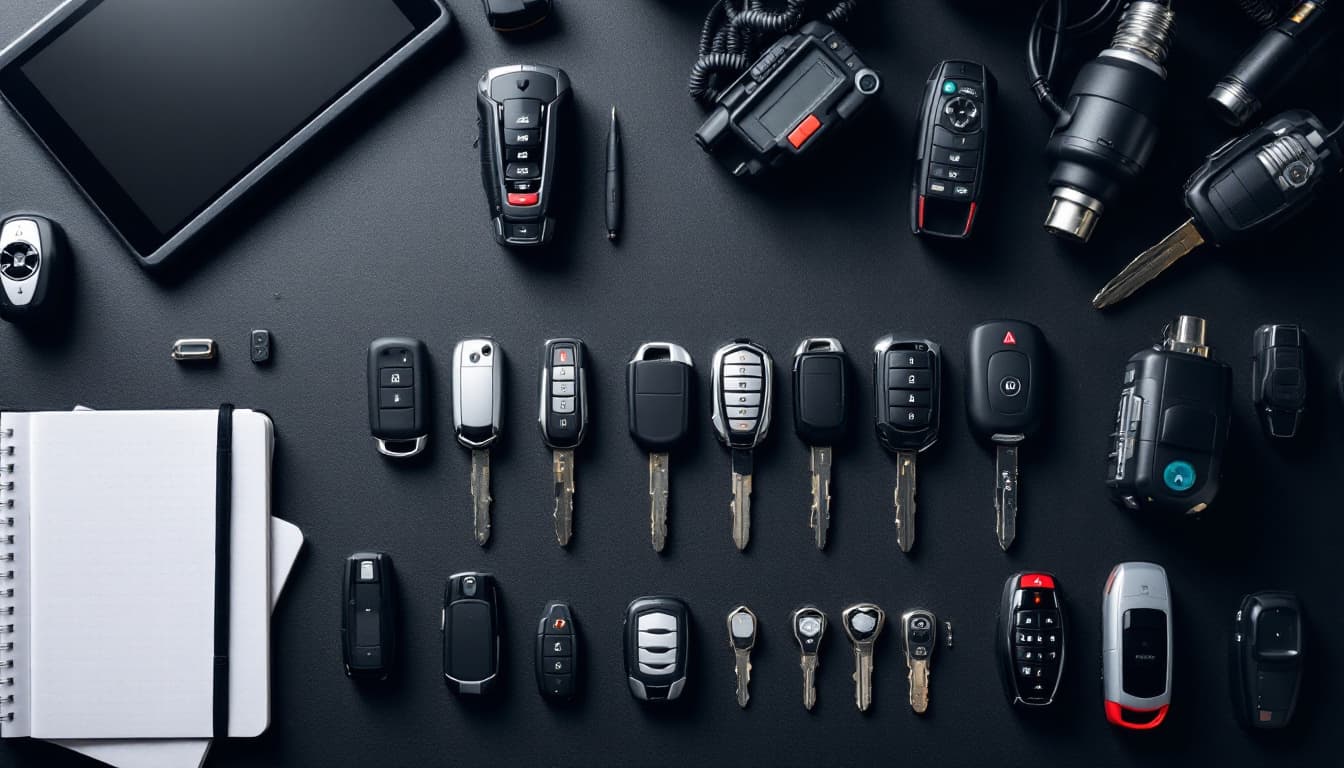
Most vehicles on Fort Worth roads can have keys cut and programmed by a qualified mobile locksmith, at the car, for less than a dealership charges — typically $130 to $450 depending on key type as of August 2026. The genuine exceptions are narrow but real: certain very recent model years, a handful of premium brands, and specific security-module scenarios where the manufacturer restricts programming to authorized channels. Call or text 817-674-2304 with your year, make, model and VIN, and you will get a straight answer on which side of that line your car sits — before anyone is dispatched.
That last part is the whole point of this article. The useful thing a locksmith can tell you is not "we can do anything." It is exactly what we cannot do, and why.
The Short Version
| Category | Can a mobile locksmith usually do it? |
|---|---|
| Bladed transponder keys, roughly 1998–2015, most makes | Yes — routine |
| Remote head and flip keys, most mainstream makes | Yes — routine |
| Smart proximity fobs, mainstream makes, adding a spare | Yes — routine |
| Smart proximity fobs, mainstream makes, all keys lost | Usually, with a longer on-site security wait |
| Newest model years across many brands | Depends — VIN check required first |
| Some premium European models, all keys lost | Often restricted; verify before dispatch |
| Vehicles needing a replacement security module | Depends heavily on make and year |
| A key the manufacturer only issues to its own network | No — dealer route |
The honest summary: the overwhelming majority of calls are in the "yes" rows. The reason we still check every VIN is that the exceptions are impossible to guess from the model name alone.
Why the Line Exists at All
For most of the 1990s and 2000s, key programming was a fairly open procedure. That changed for a good reason.
Every modern car carries an immobilizer: an encrypted credential in the key, a module in the car that verifies it, and an engine controller that refuses to run without approval. The security of that system depends on the data behind it — key codes, security PINs, immobilizer access routines — being genuinely hard to obtain.
So manufacturers moved that data behind controlled access. In the U.S., much of it flows through the National Automotive Service Task Force's Vehicle Security Professional registry and its Secure Data Release Model.
Per NASTF's Secure Data Release Model, access to key programming and immobilizer functions is granted only after business validation, criminal background checks, confirmation of professional standing, and documented proof of the vehicle owner's authority — with transactions monitored for unusual activity. — NASTF VSP Registry (SDRM)
The registry was founded in 2008 and now includes more than 9,000 participants. Getting credentialed requires business registration documents, a driver's license, a locksmith license, and consent to a background check, with a typical approval window of three to ten days.
That framework is why an independent locksmith can legitimately program most vehicles — and also why some procedures still route only through manufacturer systems. It is not a conspiracy against independents. It is the same gate that makes your car hard to steal.
Does the gate actually work?
Measurably. The National Insurance Crime Bureau reports U.S. vehicle thefts fell 23.2% from 2024 to 2025 — from 850,708 to 659,880, the lowest levels in decades — based on reports entered into the FBI-managed National Crime Information Center database. Immobilizer systems and controlled key-data access are a substantial part of that decline.
The federal baseline is FMVSS 114, the theft-protection and rollaway-prevention standard administered by NHTSA, which requires a vehicle's starting system to prevent engine activation and prevent steering or forward self-mobility whenever the key is removed (NHTSA, FMVSS No. 114).
The Four Things That Actually Decide It
Forget brand reputation. Four variables determine feasibility:
1. Model year. This is the single biggest factor. A 2012 vehicle and a 2025 vehicle wearing the same badge can be entirely different propositions. Newer generally means tighter.
2. Whether a secure gateway sits in the way. Many manufacturers now place a gateway module between the diagnostic port and the vehicle's internal networks, gating write access. Some are handled through authorized channels; some are not handled outside the dealer network at all.
3. Whether you have a working key. Adding a spare with one working key present is the easiest version of this job on almost every vehicle. All-keys-lost is where the restrictions bite hardest, because it requires the deepest level of access.
4. Whether a module is being replaced. Programming a new key is one thing. Pairing a replacement security module or engine controller to a vehicle is a much deeper operation, and availability varies sharply by make.
Where It's Routine
For the bulk of what is parked in Fort Worth driveways, mobile key work is straightforward:
- Mainstream Japanese and Korean makes across most of the last two decades — spares and, in most cases, all-keys-lost.
- Domestic sedans, SUVs and pickups through most model years, including transponder keys, remote head keys and proximity fobs.
- Older European vehicles, where key architectures are well documented.
Our make-specific pages cover the details: Toyota, Honda, Ford, and Jeep, Chrysler and Dodge.
Where It Gets Conditional
Recent model years, most brands. The newer the car, the more likely a specific procedure requires manufacturer-authorized access. There is no clean cutoff year that applies across all makes, which is exactly why we check the VIN rather than quoting from the model name.
Premium European brands on all-keys-lost jobs. Adding a spare is often achievable; recovering from zero keys is where the restrictions concentrate. Our BMW, Mercedes, Audi, Porsche and Range Rover pages exist because these need case-by-case answers, and the European car locksmith page covers the general approach.
EVs and digital-key systems. Some manufacturers handle credentials through an account and an app rather than purely at the vehicle, which changes who can do what. Tesla's card-and-app system is its own category — see Tesla key card replacement.
Module replacement scenarios. Replacing a security module or engine controller is meaningfully harder than adding a key, and feasibility varies by make and year. See our module programming page.
What "Check the VIN First" Actually Buys You
Here is the practical value, in dollars.
Without a VIN check, the sequence is: you call, someone says yes, a technician drives out, discovers your specific configuration is restricted, and you have paid for a trip that produced nothing.
With a VIN check, the sequence is: you call, we look up what your exact vehicle requires, and you either get a real quote and an appointment, or you get told to book the dealer — on the phone, at no cost.
The second outcome loses us the job. It is still the correct policy, and it is what the Federal Trade Commission's advertising guidance contemplates when it treats advertised prices that are not genuinely available as deceptive. A price you cannot actually get is not a price.
When the Dealer Is Genuinely the Right Call
There are cases where we will tell you to go to the dealership, and it is worth knowing them:
- Your vehicle is under a warranty or service program that covers the key.
- Your configuration falls in a restricted category and the work simply cannot be completed outside the manufacturer's network.
- The vehicle needs a module replacement that only the manufacturer's system can pair.
- You have no proof of ownership at all and need to establish it through the title process first.
In those cases the dealer route means a tow, an appointment, and typically several days — which is a real cost, but a smaller one than paying someone to fail at the roadside.
When a Locksmith Is Clearly Better
For everything else, the comparison is not close:
- The car does not move. No tow, no drop-off, no ride home. Work happens in your driveway, office lot or a parking garage.
- Same day, often within hours, including nights and weekends through our 24-hour locksmith line.
- Usually lower total cost, especially once the tow and the lost day are counted.
- A second key while the session is open costs the key alone — see our spare car key guide.
The general cost comparison lives on our car key replacement cost page, and the dealership-versus-locksmith breakdown is in our auto locksmith vs dealership guide.
What It Costs When a Locksmith Can Do It
Typical Fort Worth ranges, from our published cost page:
| Key type | Typical Fort Worth range |
|---|---|
| Basic mechanical key (older vehicles) | $50 – $100 |
| Standard transponder chip key | $130 – $220 |
| Remote head key | $160 – $260 |
| Flip key | $170 – $290 |
| Smart proximity fob (push-to-start) | $220 – $450 |
| Luxury / European smart key | $300 – $700+ |
| All-keys-lost surcharge | +$50 – $200 |
Typical ranges rather than a guaranteed quote — the fob part number for your VIN sets the exact figure.
What to Have Ready When You Call
The VIN. Through the windshield at the base of the driver's side, or on your insurance card and registration.
Proof of ownership. Current Texas registration or the title in your name, plus a matching government photo ID. Texas locksmith work is regulated under the Texas Department of Public Safety Private Security Program, authorized under Chapter 1702 of the Texas Occupations Code, and this verification is required. If you bought privately and the title is in process, the Texas Department of Motor Vehicles requires titling within 30 days of sale — bring the signed title or bill of sale with the prior registration.
An honest key count. Whether any key exists anywhere, including one you believe is dead. A fob with a flat battery may still hold a valid credential, and if it does, the job gets easier and cheaper.
Trade certification, for reference, runs through ALOA, the Associated Locksmiths of America.
Frequently Asked Questions
Can I get a transponder key programmed in Fort Worth, or do I need the dealership?
For the large majority of vehicles, a mobile automotive locksmith can cut and program a transponder key at your location — typically $130 to $220 for a standard chip key as of August 2026. The exceptions are certain recent model years, some premium European all-keys-lost scenarios, and module-replacement jobs. Give us your VIN and you will get a definite answer before anyone is dispatched.
How do I know if my specific car is one of the exceptions?
The VIN decides it, not the model name. Two cars of the same model and different years can require completely different access. That is a phone call, it takes a few minutes, and it costs nothing.
Why can a locksmith program keys at all if it's a security system?
Because access is credentialed rather than open. Manufacturer key data is released through the NASTF Vehicle Security Professional registry after business validation, background checks and documented proof of the owner's authority — with Texas licensing through the DPS Private Security Program on top of that.
Is the dealership always more expensive?
Not always on the part itself, but usually on the total. The dealer route commonly adds a tow for a car that will not start, an appointment days out, and a lost day — costs that do not appear on the invoice but are real.
If all my keys are lost, does that change who can help?
Often, yes. All-keys-lost requires the deepest level of access, so it is where restrictions concentrate. It is still routine on most mainstream vehicles; it is the scenario most likely to be restricted on newer or premium ones.
Can a locksmith program a key I bought online?
Sometimes, but the part number has to match your VIN and quality varies widely. A fob that unlocks the doors but will not start the car was never registered to the immobilizer. Ask before buying.
Does it matter that my car is a hybrid or EV?
Sometimes. Some manufacturers manage credentials through an owner account or app rather than purely at the vehicle, which changes the process. The 12-volt battery also matters more than people expect — no programming happens on a car with no power at the diagnostic port.
What if you tell me it needs the dealer? Do I still pay you?
No. That determination happens on the phone from your VIN, before anyone is dispatched. You lose a few minutes and nothing else.
Get the Straight Answer in Five Minutes
Do not guess from a forum post about a car three model years off yours. The VIN answers it definitively, and asking costs nothing.
Call or text 817-674-2304 with your year, make, model and VIN. If we can do it, you get a real range and a time. If we cannot, you get told to book the dealer — with the reason. Mobile automotive locksmith service across Fort Worth and Tarrant County, listed by area on our service areas page.
Article written by the Fortworthlocksmithexperts Automotive Locksmith Team. For mobile automotive locksmith service throughout Fort Worth and Tarrant County, contact us at 817-674-2304.
Locked out or need a key now?
Mobile auto locksmith service across Fort Worth and the surrounding metroplex. We come to you — 24/7.
Call 817-674-2304