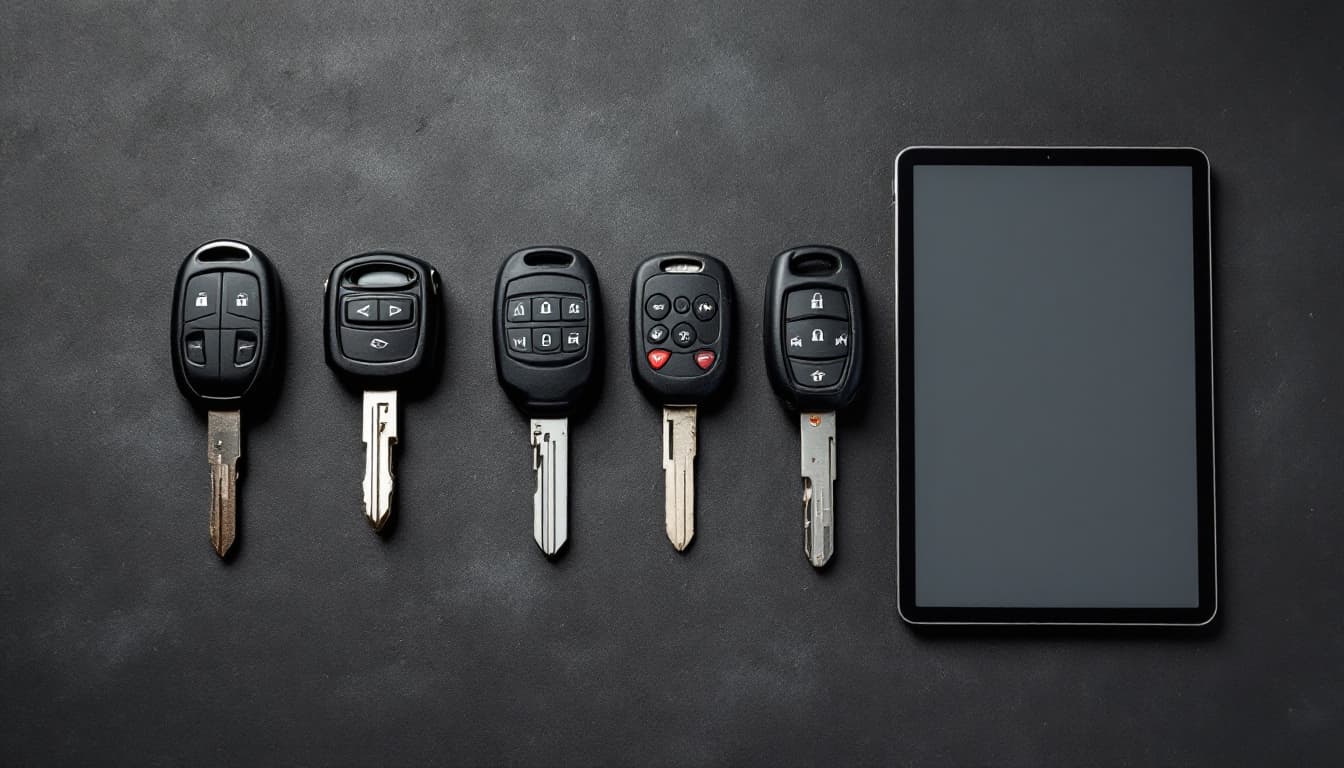
As of September 2026, most vehicles on Fort Worth roads will hold somewhere between four and eight programmed keys, and the exact ceiling belongs to the platform rather than the brand. That number matters for two reasons: when the memory is full, nothing new can be added until something is removed — and on a sizeable group of vehicles, removing means erasing every key at once and re-registering the ones you want to keep, which is why a third or fourth key sometimes costs more than the second one did. Call or text 817-674-2304 with your year, make and model and we will tell you which kind of car you own before you book anything.
Why Cars Have a Limit At All
A modern key is not just a cut piece of metal. It carries a transponder — a chip with an identity the vehicle has agreed to accept — and that agreement is a record stored in the immobilizer, the body control module or the engine controller, depending on the platform.
Records take space, and the engineers who designed the system allocated a fixed number of slots for them. That allocation is the ceiling. It is a deliberate design decision, not a fault, and it exists because the whole point of an immobilizer is to be restrictive: research from the Insurance Institute for Highway Safety and its affiliated Highway Loss Data Institute has consistently found that vehicles equipped with immobilizers are stolen at lower rates than those without them. A system that would accept unlimited keys would be a weaker system.
The practical version: your car keeps a guest list, the list has a fixed length, and your locksmith reads it before adding a name.
The Two Kinds of Car, and Why It Decides the Price
Forget brands for a moment. For pricing purposes there are two kinds of vehicle in Fort Worth.
Kind one: add-a-key platforms. The technician connects, authenticates, and writes one additional key into an empty slot. The keys already registered are untouched and keep working. If there is a free slot, this is ordinary work.
Kind two: erase-and-re-register platforms. The procedure that writes keys does not add — it replaces the entire list. Every key that should work afterwards has to be present and programmed in that one session. Any key sitting in a kitchen drawer at home, or with a relative in Keller, stops working the moment the session completes.
That distinction drives everything below. It is also the reason a technician asks how many working keys you have and asks you to bring all of them, even when you only want one more. That request is not upselling; on kind-two platforms it is the difference between ending the day with three working keys and ending it with one.
What Each Additional Key Costs
Here are our published Fort Worth bands, from the car key replacement cost page. A key is a key — the band is set by the key type, not by whether it is your second or your fourth.
| Key type | Complete job |
|---|---|
| Basic mechanical key (pre-immobilizer) | $50 – $100 |
| Standard transponder chip key | $130 – $220 |
| Remote head key | $160 – $260 |
| Flip key | $170 – $290 |
| Smart proximity fob (push-to-start) | $220 – $450 |
| Luxury / European smart key | $300 – $700+ |
| All-keys-lost surcharge | +$50 – $200 |
What changes with the third and fourth key is not the band. It is how many visits those keys take, and on kind-two platforms, how many keys have to be in the room.
The saving available here is real and entirely practical: the trip and the programming setup happen once per appointment, not once per key. Two keys cut and registered in one visit involve one journey, one authentication session and one set of paperwork. The same two keys a fortnight apart involve all of that twice. When you call, ask for both quoted together rather than asking what one costs and doubling it — that is where the difference sits.
How to Tell Which Kind of Car You Own
You will not find this in the owner's manual, which is genuinely irritating. What you can do is narrow it before you call:
Count what you have. If you hold two or more working keys today, that already tells a technician something useful about the vehicle's history.
Note the key type. A bladed transponder, a remote head key, a flip key and a smart proximity fob sit on different sides of this line more often than their badges do. Our transponder key and push-to-start key pages describe the two most common families.
Give the year precisely. Manufacturers change security architecture mid-generation, and a 2015 and a 2017 of the same nameplate can behave completely differently. This is the same reason we wrote car key replacement cost by model year — the year is frequently a bigger variable than the badge.
Then let the technician read the module. That reading is quick, it is done before anything is written, and it turns all of the above from an educated guess into a fact.
"The Shop Said My Car Is Full"
It happens, and it is usually one of three situations.
Genuinely at the ceiling. Long-owned vehicles accumulate keys — the two that came with it, one made at a dealer in 2019, one made when the second driver joined the household. Four or five later, the list is full.
Full of keys that no longer exist. This is the common one. A slot occupied by a key that was lost in 2021 is still occupied. The car does not know the key is gone; it only knows it is registered. The fix is the erase-and-re-register cycle, and it has an obvious security benefit alongside the practical one: keys you cannot account for stop working.
Not full, but the platform is kind two. Nothing is wrong at all. The procedure simply rewrites the list, so every key has to be present.
All three end in the same instruction, which is why it is worth stating plainly: bring every working key you want to keep working.
The Case for Deliberately Clearing the List
There is a scenario where erasing everything is the goal rather than the obstacle.
If you bought the car used, you inherited its guest list. A used vehicle can easily carry a key held by a previous owner, a relative of theirs, or a dealership that never returned the second one. The car will not tell you; it accepts whatever is registered.
That is not a hypothetical concern on a vehicle parked in a driveway with the registration in the glovebox. Erasing every key and registering only the ones in your hand is the one operation that resolves it, and it belongs on the list of things worth doing in the first month of ownership — alongside the ordinary checks. The same logic applies after a break-in, which we cover in more depth on the lost car keys page.
Do Valet Keys and Emergency Blades Take Up a Slot?
A fair question, and the answer splits neatly.
A plain mechanical blade takes no slot. The emergency blade that slides out of a proximity fob, or a cut-only key made to open a door and nothing else, carries no transponder. The immobilizer has never heard of it, so it occupies nothing. That is also why such a key opens the door and will not start the engine — it is not a credential, it is a piece of metal.
A valet key does take a slot. Where a manufacturer supplies one, it is a fully registered credential with deliberately reduced privileges — commonly no boot or glovebox access. The immobilizer counts it like any other key.
A dealer's spare that never came home takes a slot too. This is the one that catches used-car buyers: a key nobody in your household has ever held is still on the list, still counted against the ceiling, and still capable of starting the car.
So when a technician reports the count, remember that the number reflects credentials, not key-shaped objects in your drawer.
Where the Ceiling Becomes an Argument for a Spare
The most expensive version of this subject is the one where the count reaches zero rather than the ceiling.
With at least one working key present, a technician has a credential to work from and the job stays in the ordinary band. With no working key at all, the work changes shape entirely: the cutting code has to be derived for a lock nobody has read, and authorisation has to be established on a vehicle that cannot prove anything about itself. That is the $50 – $200 all-keys-lost surcharge in the table, and the full arithmetic is in spare key now vs all keys lost later.
On a kind-two platform, having exactly one key is a particularly thin margin. Losing it means the next session starts from nothing, and every key that is ever made afterwards has to be made in that one session.
What the Technician Actually Does
For anyone who likes knowing what is happening in their driveway, the sequence on a modern vehicle runs roughly like this.
First, identification and authorisation. A legitimate technician verifies that the vehicle is yours before touching the security system — registration or title plus photo ID. This is not bureaucracy; it is the standard that makes the whole trade workable, and it is mirrored at the industry level by the National Automotive Service Task Force, whose Secure Data Release Model identity-vets independent technicians before manufacturers release key and security data to them.
Second, reading the module: how many keys are registered, how many slots remain, and which procedure this platform requires.
Third, the mechanical half — cutting a blade to the vehicle's lock, where the key has one.
Fourth, the registration itself. Some platforms complete in a couple of minutes; others impose a mandated security delay measured in double-digit minutes, during which nothing can be rushed. If your vehicle is one of those, the technician should say so in advance. A short list of vehicles where independent programming is genuinely restricted lives in which cars need the dealer for key programming.
Finally, testing every key that is meant to work — all of them, individually, doors and ignition. On a kind-two platform this step is not a formality.
Five Questions Worth Asking When You Book
- Is my vehicle an add-a-key platform or an erase-and-re-register one? The single most consequential answer.
- Should I bring my other keys? If the answer is yes, it is not optional.
- How many keys are currently registered? Read from the module, not guessed.
- Can you quote two keys together? The trip and the setup happen once.
- Are any of my existing keys going to stop working today? Nobody should discover this afterwards.
A shop that answers all five without hedging has done your vehicle before.
Licensing, Because It Belongs in This Conversation
Any work that writes to a vehicle's security memory deserves a licensed technician. Texas regulates the trade through the Texas Department of Public Safety Private Security Program — not TDLR, which is a frequent mix-up. Ask for the company licence number.
The Federal Trade Commission and the Better Business Bureau both publish consumer guidance on locksmith pricing practices, and the pattern they describe — a national headline price, an unknown local subcontractor, a different number on arrival — is worth recognising before you hand anyone access to your immobilizer.
Mobile Service Across Fort Worth and Tarrant County
We do this work at the vehicle, which for key-count work is genuinely convenient: the keys in the kitchen drawer are a few steps away rather than a separate trip. We cover Fort Worth and the surrounding Tarrant County cities including Arlington, Hurst, Bedford, Euless, Haltom City, Keller and North Richland Hills.
If the reason you are reading this is that a fob has started behaving strangely rather than that you want another one, what happens during a mobile key fob replacement walks through a real appointment, and key fob programming covers the service itself.
Frequently Asked Questions
How many keys can a car have programmed to it?
Most vehicles hold somewhere between four and eight programmed keys, and the ceiling belongs to the platform and model year rather than the brand. The only reliable way to know yours is to have a technician read the module, which takes a moment and happens before anything is written.
Why would adding a key erase my existing keys?
Because some platforms do not support adding a key at all — the programming procedure rewrites the entire list of accepted keys. On those vehicles every key you want to keep has to be present and re-registered in the same session, which is why technicians ask you to bring them.
Does the third or fourth key cost more than the second?
The band is set by the key type, not by the sequence, so a fourth transponder costs what a second one costs. What changes is the number of visits and whether an erase-and-re-register cycle is needed. Two keys made in one appointment is cheaper than two appointments because the trip and the setup happen once.
My car is full and I need another key. What happens?
The technician erases the registered list and re-registers the keys you want, including the new one. Bring every working key you intend to keep. Any key left at home will stop working, which is usually a feature rather than a problem if some of those keys are unaccounted for.
Should I erase old keys on a used car I just bought?
It is worth doing. A used vehicle carries whatever key list the previous owner left behind, and the car cannot tell you who still holds one. Erasing and re-registering only the keys in your hand is the one operation that resolves that, and it is ordinary work rather than a special procedure.
Do I need to bring all my keys to the appointment?
On erase-and-re-register platforms, yes, and it is not optional. On add-a-key platforms it is not strictly required, though bringing them lets the technician verify every key works before leaving. Ask which kind your vehicle is when you book.
Can a locksmith tell me how many keys are registered to my car?
Yes. The current count is read from the immobilizer or body module during the same connection used to program, and reading it does not change anything. It is the first thing worth asking about on a used vehicle with an unknown history.
Is there any way to raise the limit on how many keys my car accepts?
No. The number of slots is fixed in the vehicle's design and cannot be expanded. If you genuinely need more working keys than the ceiling allows, the practical answer is deciding which keys matter and re-registering that set.
Get the Answer Before You Book
Whether your vehicle adds keys or rewrites them decides how the appointment goes, and it is a two-minute question.
Call or text 817-674-2304 with your year, make, model and how many working keys you have. We will tell you which kind of car you own, whether to bring the others, and quote every key you want in one number.
Article written by the Fortworthlocksmithexperts Automotive Locksmith Team. For mobile automotive locksmith service throughout Fort Worth and Tarrant County, contact us at 817-674-2304.
Locked out or need a key now?
Mobile auto locksmith service across Fort Worth and the surrounding metroplex. We come to you — 24/7.
Call 817-674-2304