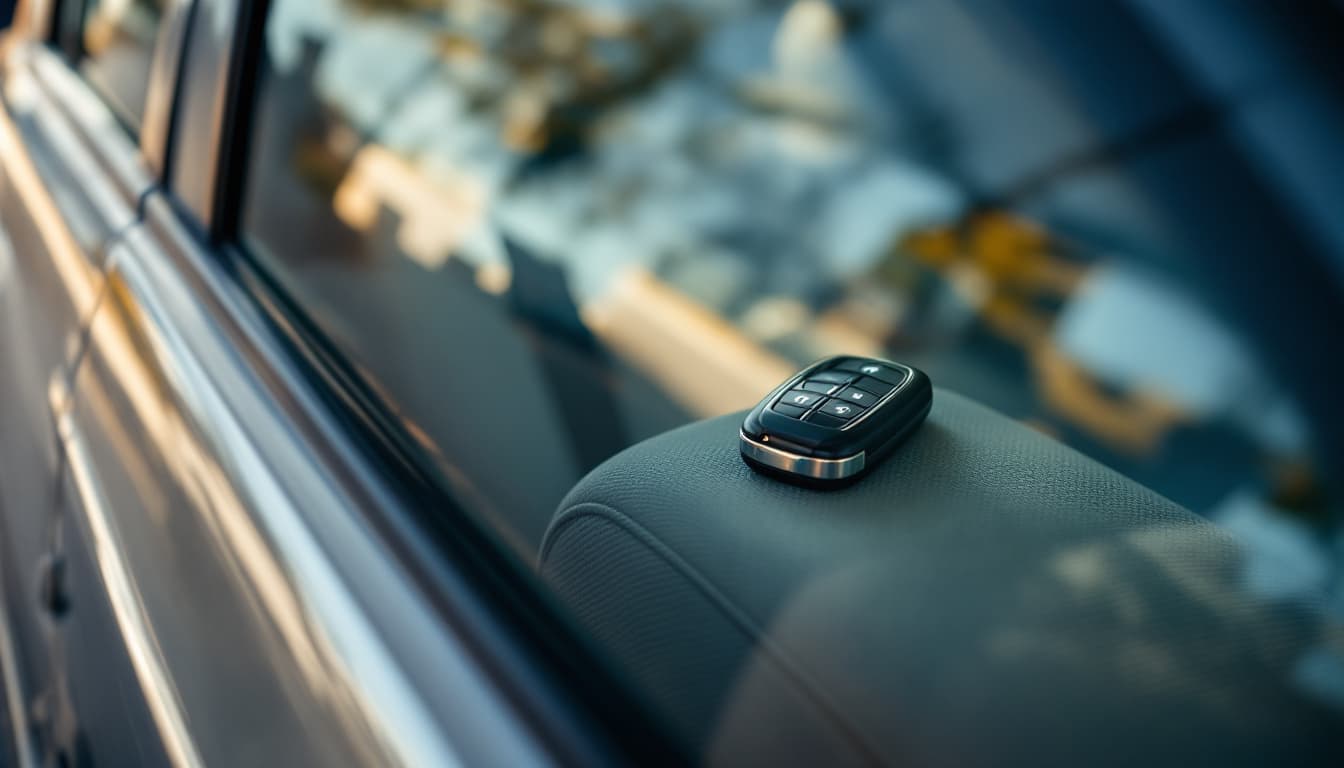
You put a bag in the back seat, shut the door, and heard the locks drop. The fob is on the seat, in plain sight, half a metre away and completely unreachable.
The first thing worth saying: that is not you being careless. Modern vehicles actively lock themselves under several documented conditions, and most drivers have never been told which ones apply to their car. There are six mechanisms behind virtually every "it locked itself" call we take in Fort Worth, and each one has a different prevention.
Right now, the immediate answer is a mobile lockout — we come to the vehicle, open it non-destructively, and you keep your day. Call or text 817-674-2304 with the year, make, model, and exactly where the car is parked. Read on afterwards, because part two of this is making sure it does not happen again.
Do These Three Things First
Before anyone drives out, thirty seconds of checking has genuinely resolved a share of these calls.
- Try every door, the tailgate, and the trunk release. Auto-lock behaviour is not always uniform across every opening, and a rear door or liftgate is left unlocked more often than people assume.
- Check whether anyone else has the second key. A spouse ten minutes away beats any service call ever invented.
- Look at your phone. If the vehicle has a connected-services app with remote unlock and your account is set up, the door opens from where you are standing. Most owners who have this have never enabled it.
If none of those land, it is a lockout. Skip to the safety section below if there is a child or a pet in the vehicle — that changes everything about what you should do next.
The Six Reasons Cars Lock Themselves
| Mechanism | What triggers it | How to stop it |
|---|---|---|
| Auto-relock timer | Unlocked but no door opened within ~30–60 seconds | Open a door promptly after unlocking |
| Walk-away auto-lock | Fob leaves the detection zone with all doors shut | Do not leave the fob inside while stepping away |
| Door handle lock button | Touching the sensor pad with a fob still inside | Confirm the fob is on you before touching the handle |
| Remote start relock | Vehicle secures itself during a remote-start run | Never leave the fob in a remote-started car |
| Fob pressed by accident | Fob in a bag or pocket in the car, buttons compressed | Keep the fob out of squeezed spaces |
| Trunk or cargo lock-in | Fob set down in the trunk, lid closed | Never put the fob down in a trunk |
1. The auto-relock timer
Nearly every keyless vehicle re-locks itself if you unlock but never open a door — typically after 30 to 60 seconds. It exists so a fob pressed accidentally in your pocket does not leave your car open all night in a Fort Worth lot.
It bites when you unlock from a distance, get distracted, and come back after the timer has expired — sometimes with the fob having already been set down inside during the brief window it was open.
2. Walk-away auto-lock
Newer vehicles lock automatically when the proximity fob leaves the detection zone and all doors are closed. Convenient and generally excellent. It becomes a lockout in exactly one situation: the fob is inside the car and you walk away holding a different key or nothing at all. Some implementations also lock on a timer after the fob is no longer detected — including when the fob is inside but its battery is too weak to be seen.
That last variation is the sneaky one, and it connects directly to a fob that has been getting unreliable: a weak fob can be invisible to the car even while sitting on the seat. If your fob has been intermittent lately, that is worth reading about separately in our guide to a fob that works sometimes and then does not.
3. The handle lock pad
Push-button vehicles have a lock sensor on the door handle — a button, a ridged pad, or a touch-sensitive area. Brushing it while closing the door with a full armload locks the car. If the fob happens to be on the seat rather than in your pocket, that is the whole event.
Most vehicles are designed to refuse this when they can still detect a fob inside. Detection is not perfect: a fob in a metal-framed bag, inside a laptop sleeve, in a centre console, or with a weak battery may not be seen.
4. Remote start
A remote-started vehicle keeps itself locked while it idles, by design — an unlocked running car is a theft waiting to happen. If the fob is inside during that run, you have a locked, running car and nothing to open it with. In a Fort Worth August this also means a car burning fuel with the air conditioning on while you stand outside it.
5. The fob pressed itself
A fob loose in a gym bag, under a laptop, or wedged in a seat gap gets its buttons compressed by weight. Sometimes it locks, and on vehicles where a long press does more, it can close windows and sunroofs too.
6. The trunk
Setting the fob down in the trunk while loading is the classic version. Many vehicles now refuse to lock a trunk with a fob detected inside — but the same detection limits from mechanism three apply, and a trunk full of metal is a worse radio environment than a passenger cabin.
Which One Was It? Match Your Situation
- Doors locked while you stood next to the car → walk-away auto-lock or the handle pad.
- You unlocked, got distracted, came back locked → auto-relock timer.
- The engine is running and the doors are locked → remote start, or you started it and stepped out.
- The fob was in a bag in the car → accidental button press.
- You were loading the trunk → trunk lock-in.
- It has happened more than once recently → a weak fob battery is a strong candidate, because a fob the car cannot detect defeats every "do not lock with the key inside" protection at once.
That last pattern is worth taking seriously. Two lockouts in a month is usually not bad luck; it is a coin cell.
Safety First: A Child or Pet Inside
This is not a judgement call and it is not a lockout in the ordinary sense.
If a child or an animal is locked in the vehicle, call 911 first. Then call for a locksmith. A closed car in Texas summer heat reaches dangerous interior temperatures within minutes, not hours, and emergency services are equipped and authorised to make the fastest possible entry.
We will still come, and quickly. But the correct call order in that situation is emergency services first, every time. Do not wait for an ETA from anyone.
How a Mobile Lockout Actually Works
A proper automotive lockout is non-destructive. No broken window, no drilled lock, no bent frame.
Verification. The technician establishes you are entitled to the vehicle — registration or insurance card plus a matching photo ID. Texas locksmith work is licensed by the Texas DPS Private Security Program under Chapter 1702 of the Texas Occupations Code — a licensed technician verifying ownership before opening a car is the system working, not an obstacle. When your ID is locked inside with everything else, say so on the phone and we will tell you what else works.
Entry. A controlled gap at the top of the door frame, protected so paint and weather seal are not damaged, and a long tool to reach the interior lock control or handle. Modern side-curtain airbags live in the roof rail, which is exactly why this is trained work rather than a coat hanger.
A look at why it happened. If the fob turns out to be weak, you will hear that, because the fix is a coin cell and not another lockout next month.
Most lockouts are minutes of work once someone is on site. The variable is travel, which is why the location detail matters when you call. Our car lockout page covers the service, and locked keys in car covers this exact scenario.
One thing not to do: the "unlock it with a tennis ball" and coat-hanger videos do not work on modern vehicles and reliably produce a bent door frame, a scratched window channel, or a deployed airbag. The repair costs vastly more than the lockout.
After You Are Back In: Stop It Happening Again
Replace the fob's coin cell if it has been more than a couple of years, and immediately if lockouts have repeated. A few dollars.
Have a real second key. Not a fob in the glovebox — a key somewhere else entirely: a partner, a desk drawer, a home hook. As of August 2026 a spare proximity fob in Fort Worth runs $220 – $450 and a remote head key $160 – $260. That is bounded, one-time, and cheaper than the all-keys-lost path, which adds $50 – $200 on top. See key fob replacement or car key replacement.
Check the emergency blade in your proximity fob. Press the release, pull the blade out, and look at the edge. Milled wave pattern means it is cut and will open your driver's door cylinder. A smooth flat blank means it is decorative — it looks identical and it will not enter the lock. Many fobs ship uncut and the owner never finds out until the day it matters. Cutting it is a short standalone job.
Find your door cylinder now. On many current vehicles the driver's cylinder hides under a small cap on the handle. Pop it once in daylight so you are not learning where it is at 11 PM.
Set up the connected-services app if your vehicle supports remote unlock. It is free capability most owners never activate.
Why Cars Are Built to Lock Themselves
The behaviour that stranded you exists for a documented reason.
FMVSS No. 114 — Theft Protection and Rollaway Prevention, codified at 49 CFR 571.114 and administered by the National Highway Traffic Safety Administration:
Each vehicle must have a starting system which, whenever the key is removed from the starting system, prevents the normal activation of the vehicle's engine or motor, and either steering or forward self-mobility of the vehicle or both. — 49 CFR § 571.114, Standard No. 114
Since 1991 the standard has additionally required that vehicles with an automatic transmission having a Park position prevent key removal unless the transmission is locked in Park (Federal Register, FMVSS No. 114). Auto-lock and walk-away locking are the manufacturers' extension of that same anti-theft logic into the keyless era.
It works. The National Insurance Crime Bureau reports U.S. vehicle thefts fell 23.2% from 2024 to 2025 — 850,708 down to 659,880, per the FBI-managed National Crime Information Center — the lowest levels in decades. The price of a car that is hard to steal is a car that occasionally locks you out, which is also why entry and key work is licensed: independent technicians reach manufacturer key data through the National Automotive Service Task Force's Vehicle Security Professional registry and its Secure Data Release Model, with trade certification through ALOA.
Mobile Lockout Service Across Fort Worth
We reach vehicles throughout Fort Worth — downtown and the medical district, the Stockyards, TCU and the near south side, Wedgwood and the southwest, Alliance and the far north, Ridgmar and the west side — plus Arlington, Keller, North Richland Hills, Hurst, Bedford, Euless, and Haltom City. Full list on service areas. Overnight and holiday calls go through 24 hour locksmith; a stranded vehicle on a shoulder should start at emergency auto locksmith. If you are new to the service, car locksmith Fort Worth is the overview.
Frequently Asked Questions
Why did my car lock itself with the keys inside?
Six mechanisms cause almost all of these: the auto-relock timer after an unlock with no door opened, walk-away auto-lock, the lock pad on the door handle, remote-start relocking, a fob pressed accidentally inside a bag, and setting the fob down in a trunk.
Should the car not refuse to lock if the fob is inside?
Most try to. Detection is imperfect — a fob in a metal-framed bag, inside a console, or with a weak battery may be invisible to the car, and an undetected fob defeats that protection entirely.
My car has locked itself twice this month. What is wrong?
Most likely a weakening fob battery. A fob the vehicle cannot detect looks like no fob at all, so the anti-lockout logic never engages. Replace the coin cell before assuming the car is faulty.
A child or pet is locked in the car. What do I do?
Call 911 first, then call for a locksmith. Interior temperatures rise dangerously fast in Texas heat and emergency services can make the fastest authorised entry. Do not wait on any service ETA.
Will a locksmith damage my car opening it?
A trained automotive lockout is non-destructive. A protected gap at the door frame plus a long-reach tool operates the interior control without damaging paint, seal, or the door. The coat-hanger and tennis-ball methods online are what cause damage.
What do I need to prove the car is mine if my ID is locked inside?
Say that when you call. Texas licensing requires ownership verification, but there are workable alternatives — a registration accessible digitally, an insurance app, or a titled owner reachable by phone. It is a solvable problem, not a dead end.
Can you unlock a car that is running from a remote start?
Yes. A remote-started vehicle keeps itself locked by design, which is a common way the fob ends up sealed inside. It is a standard lockout once a technician is on site.
How much does a spare key cost so this stops happening?
As of August 2026, a spare proximity fob runs $220 – $450 in Fort Worth and a remote head key $160 – $260, including programming. Making one while you still have a working key avoids the $50 – $200 all-keys-lost surcharge entirely.
Locked Out Right Now?
Call or text 817-674-2304 with your year, make, model, and precisely where the vehicle is parked — the more exact the location, the faster someone reaches you.
And once you are back inside, do the two small things on this page: check the coin cell, and check whether the emergency blade in your fob was ever actually cut. Between them they prevent most repeat lockouts, and neither one costs much of anything.
Article written by the Fortworthlocksmithexperts Automotive Locksmith Team. For mobile automotive locksmith service throughout Fort Worth and Tarrant County, contact us at 817-674-2304.
Locked out or need a key now?
Mobile auto locksmith service across Fort Worth and the surrounding metroplex. We come to you — 24/7.
Call 817-674-2304